
Electrostatic discharge remains one of the most insidious threats in electronics manufacturing. A single uncontrolled ESD event—often undetectable to operators—can compromise integrated circuit functionality, introducing latent defects that manifest months later in field applications. Research published in the Journal of Electrostatics demonstrates that organisations achieving robust ESD compliance can realise returns on investment approaching 1000% through reduced scrap rates and warranty claims.
Yet effective protection requires more than purchasing antistatic mats and wrist straps. The 2024 revision of IEC 61340-5-1 establishes that proper ESD control programmes must address four interdependent factors: grounding infrastructure, packaging material selection, EPA zone design, and personnel discipline. This article examines each factor through the lens of practical implementation and compliance verification.
Your 4 critical priorities for effective ESD control:
- Establish continuous grounding verification systems for personnel and equipment
- Match packaging materials to device sensitivity classifications (HBM/CDM thresholds)
- Design EPA zones meeting IEC 61340-5-1 environmental and monitoring specifications
- Implement documented training programmes with periodic competency verification
Factor 1: Proper Grounding and Bonding Systems
Grounding forms the foundation of every ESD control strategy. Without reliable electrical continuity between charged objects and earth ground, even the most sophisticated EPA infrastructure fails to protect sensitive components. The principle remains straightforward: provide a controlled path for electrostatic charges to dissipate harmlessly before reaching vulnerable device junctions.
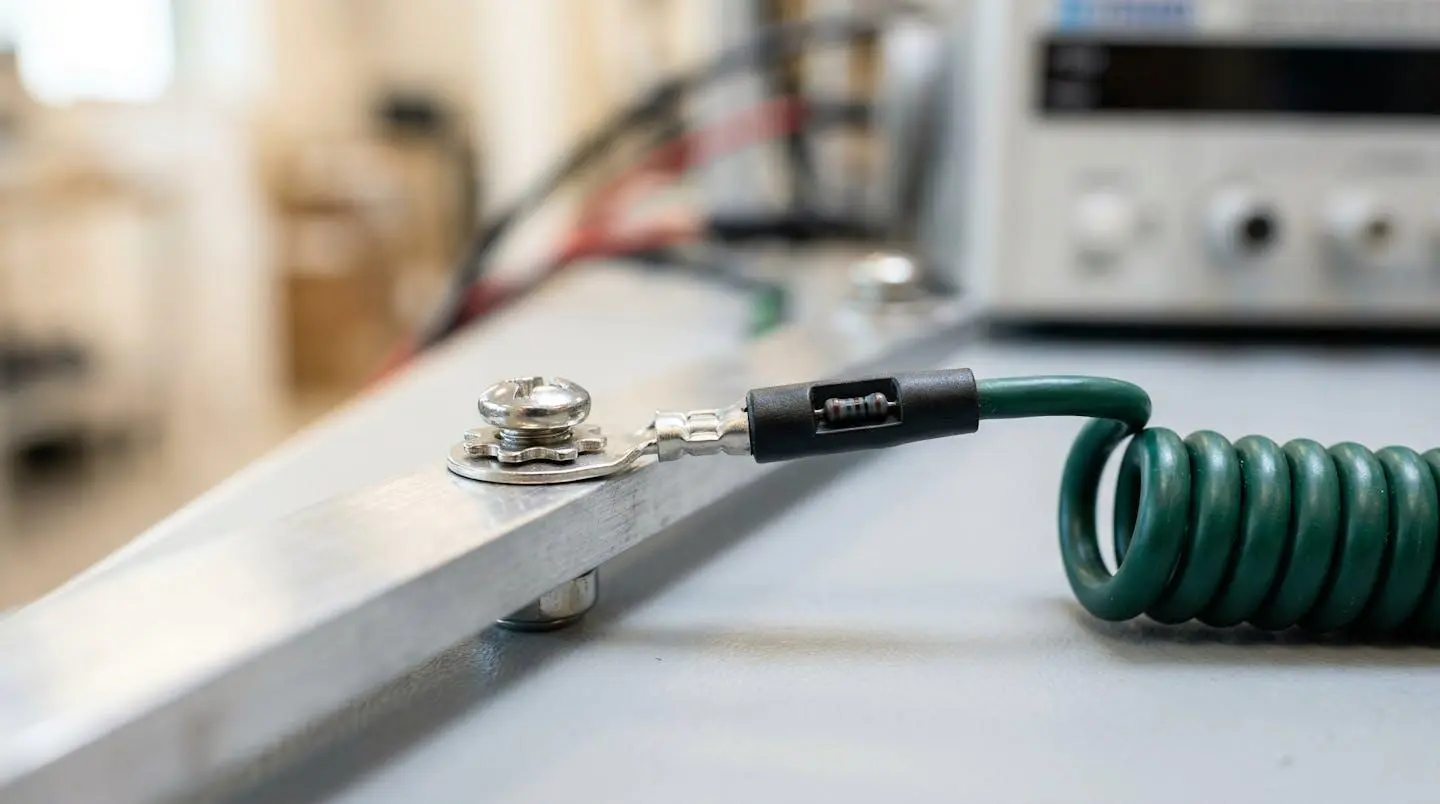
Personnel grounding typically relies on wrist straps incorporating current-limiting resistors. According to EOS/ESD Association fundamental principles, these resistors serve dual purposes—enabling static charge dissipation whilst protecting operators from electrical hazards should they contact live circuits. The standard resistance value of 1 megohm balances these requirements, allowing charge bleed-off over milliseconds rather than instantaneous discharge.
⚠ Common Grounding System Failures
Compliance audits frequently identify three recurring failure modes: worn or damaged wrist strap cords creating intermittent connections, ground points exceeding resistance specifications due to oxidation or loose hardware, and missing daily verification procedures. Field observations reveal that grounding integrity issues—particularly connection reliability and equipment wear—represent a leading cause of EPA audit failures, rather than more visible problems like improper flooring or inadequate signage.
Workstation grounding requires equal attention. ESD mats must maintain electrical continuity to the facility’s common ground point, with surface resistance remaining within specified ranges to prevent charge accumulation. Regular testing using calibrated megohmmeters verifies that resistance values fall between acceptable thresholds—sufficient to dissipate charges without creating shock hazards.
The most sophisticated facilities implement continuous monitoring systems that provide real-time verification of grounding integrity. These systems detect open circuits or resistance drift instantly, alerting operators before ESD-vulnerable handling occurs. Whilst representing a higher initial investment than periodic manual testing, continuous monitors eliminate the risk window between verification checks and provide audit trail documentation automatically.
Factor 2: ESD-Safe Packaging and Material Selection
Packaging represents the primary defence for PCB assemblies during transport and storage—the periods when components exit the controlled EPA environment. Material selection must account for both the electrostatic protection required and the environmental conditions components will encounter.
Shielding bags utilise the Faraday cage principle, employing conductive outer layers that prevent external electrostatic fields from reaching enclosed assemblies. These metallised films prove essential when handling devices sensitive to field-induced charging, particularly components rated below 100 volts human body model sensitivity. The IEC 61340-5-1:2024 standard specifies that organisations handling parts with withstand voltages at or above 100V HBM and 200V CDM must implement appropriate packaging as part of their ESD control programme.
When implementing comprehensive ESD protection circuit measures across production environments, material selection becomes increasingly critical. Professional-grade packaging solutions combine multiple protective layers—an outer abrasion-resistant film, a conductive Faraday shield, and an inner antistatic layer contacting components directly. This multi-layer architecture addresses diverse failure modes: mechanical damage, external field induction, and triboelectric generation from bag-to-component friction.

Material selection depends on device sensitivity, environmental exposure, and cost constraints. The comparison below highlights key differentiation factors:
| Material Type | Protection Level | Typical Application | Cost Factor |
|---|---|---|---|
| Shielding Bags (Metallised) | Highest (Faraday cage) | High-sensitivity ICs, RF components | Premium |
| Moisture Barrier Bags (MBB) | High (ESD + humidity) | Moisture-sensitive devices, long-term storage | Premium |
| Pink Poly Bags (Antistatic) | Moderate (dissipative) | General PCB assemblies, short-term handling | Economical |
| Conductive Foam | Moderate (contact protection) | Component pin protection, secure positioning | Moderate |
Moisture barrier bags deserve particular attention when handling devices sensitive to both ESD and humidity exposure. These specialised films incorporate desiccant layers alongside electrostatic shielding, addressing the dual challenge of moisture-induced corrosion and charge-related damage during extended storage periods or shipment through varying climatic zones.
Cost optimisation comes from matching protection level to actual device sensitivity rather than defaulting to maximum protection universally. Assemblies populated exclusively with robust components rated above 2000V HBM may perform adequately in standard pink poly bags, reserving premium shielding materials for the minority of builds containing highly sensitive analogue or RF circuitry.
Factor 3: EPA (ESD Protected Area) Design and Compliance
The EPA zone represents the controlled environment where ESD-sensitive handling occurs. Proper design integrates multiple protective elements—flooring systems, workstation surfaces, environmental controls, and ionisation equipment—into a cohesive protective infrastructure.
Flooring forms the foundation of EPA design. Conductive or dissipative floor finishes provide a controlled path for operator charges to reach ground through footwear or heel grounders. Fundamental principles outlined in industry standards emphasise that both ANSI/ESD S20.20 and IEC 61340-5-1 require written compliance verification plans, though organisations retain flexibility in determining specific implementation approaches suited to their processes.

Ionisation equipment addresses the challenge of insulating materials that cannot be grounded directly. Air ionisers generate balanced streams of positive and negative ions that neutralise static charges on plastic component carriers, non-conductive packaging, and other unavoidable insulators within the EPA. Regular performance verification ensures ionisers maintain proper balance and achieve specified decay times—the interval required to reduce charge levels to safe thresholds.
Environmental monitoring proves particularly important for facilities operating in variable climates. Relative humidity significantly affects triboelectric charging rates, with very dry conditions (below 30% RH) dramatically increasing charge generation during material handling. Conversely, excessive humidity introduces condensation risks. The relationship between advanced component complexity and stringent environmental requirements has grown more pronounced, as the impact of modern PCB technologies demands increasingly rigorous controls to protect miniaturised, densely-packed circuitry operating at lower voltages.
Use the following verification steps to audit EPA compliance systematically:
EPA Compliance: Your 8 Verification Steps
- Measure floor resistance point-to-groundable-point using calibrated megohmmeter
- Verify workbench surface resistance falls within manufacturer specifications
- Confirm common ground point system remains operational and accessible
- Test wrist strap functionality daily using dedicated verification unit
- Validate ioniser balance and decay time during initial setup and periodic reviews
- Monitor relative humidity continuously with target range of 30-70% RH
- Ensure EPA zone signage remains clearly visible at all entry points
- Maintain current audit documentation and personnel training records
Signage and access control complete the EPA infrastructure. Clear visual indicators establish boundaries between controlled and uncontrolled areas, reinforcing that special procedures apply within the zone. Some facilities implement physical access controls—turnstiles requiring wrist strap verification before entry—though many rely on procedural compliance supported by regular auditing.
Factor 4: Personnel Training and Procedural Discipline
Technical controls prove ineffective without operator understanding and consistent procedural adherence. Even perfectly designed EPAs fail when personnel bypass safety equipment or handle components carelessly, underscoring that the human element represents both the greatest vulnerability and the most critical control point. Industry data reveals the critical role of human factors in programme effectiveness:
60-70%
Estimated proportion of ESD programme failures attributable to human factors—inadequate training, procedural shortcuts, or inconsistent equipment use—rather than technical equipment deficiencies
Initial training must address both the scientific rationale for ESD controls and the specific procedures required in daily operations. Explaining why components fail at voltages far below human perception thresholds (typically 3000V) helps operators understand that the absence of felt shock does not indicate safety. Understanding the principles of integrated circuit design reinforces why modern devices exhibit such extreme sensitivity—gate oxide layers measured in nanometres simply cannot withstand the field strengths generated by everyday static accumulation.
Consider a mid-sized PCB assembly facility in the West Midlands experiencing intermittent component failures traced to ESD damage. Initially, operators verified wrist straps manually at shift start, with compliance declining to 60% by mid-shift. After implementing continuous monitoring systems coupled with monthly hands-on competency assessments, the facility reduced ESD-related scrap from 2.8% to 0.4% over six months—demonstrating the measurable return on investment of sustained personnel discipline beyond initial training.
Procedural training translates theory into practice. Operators must demonstrate competency in wrist strap donning and verification, proper component handling techniques (avoiding contact with device leads or exposed circuitry), and correct use of ESD packaging. Practical assessments verify that personnel can execute these procedures consistently rather than simply acknowledging understanding during classroom instruction.
Periodic refresher training combats procedural drift—the gradual erosion of compliance that occurs as familiarity breeds complacency. Documented training programmes with scheduled updates ensure that personnel maintain awareness as staff turnover introduces new operators and evolving component technologies demand updated handling protocols. Compliance verification testing at regular intervals provides objective evidence that training effectiveness persists beyond initial instruction.
Behavioural reinforcement systems support sustained compliance. Some organisations implement visual management techniques—displaying ESD event counters or compliance metrics prominently—to maintain awareness. Others incorporate ESD adherence into performance evaluations, establishing that procedural discipline carries equivalent weight to productivity or quality metrics. The most effective programmes combine positive reinforcement (recognising consistent compliance) with corrective action for repeated violations, creating a culture where ESD protection becomes reflexive rather than requiring conscious effort.
Effective ESD control emerges from the disciplined integration of these four factors rather than isolated implementation of individual elements. Organisations that treat grounding, packaging, EPA design, and personnel training as interdependent system components—each reinforcing the others—achieve the robust protection that transforms ESD control from a compliance burden into a measurable competitive advantage through reduced failure rates and enhanced product reliability.