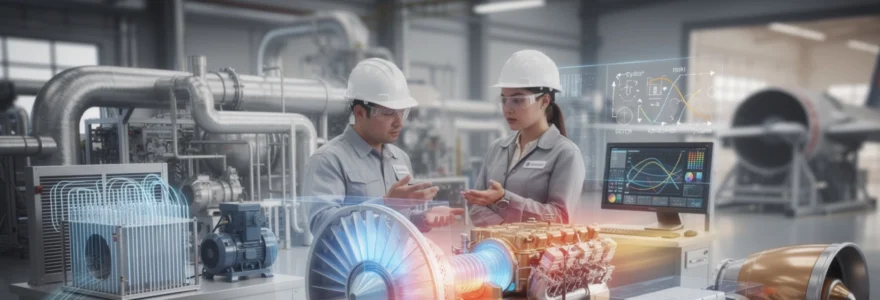
Thermodynamics serves as the fundamental backbone of mechanical engineering, governing every energy transformation and heat transfer process that engineers encounter daily. From the roaring engines of commercial aircraft to the quiet hum of refrigeration systems, thermodynamic principles shape how mechanical systems convert energy, manage heat, and optimise performance. Modern mechanical engineering relies heavily on these time-tested laws to design efficient, sustainable, and economically viable solutions across industries ranging from automotive manufacturing to power generation.
The discipline has evolved dramatically since the industrial revolution, yet its core principles remain as relevant today as they were centuries ago. Contemporary mechanical engineers must master thermodynamic concepts not merely as theoretical knowledge, but as practical tools for solving real-world challenges. Whether developing next-generation hybrid vehicles or designing energy-efficient HVAC systems, understanding how energy behaves under different conditions determines the success or failure of engineering projects.
First and second laws of thermodynamics in heat engine design
The foundation of heat engine design rests firmly on the first and second laws of thermodynamics, which together dictate both energy conservation and the inevitable limitations of energy conversion efficiency. The first law establishes that energy cannot be created or destroyed, only transformed from one form to another, whilst the second law introduces the concept of entropy and explains why no heat engine can achieve 100% efficiency.
Modern heat engine design requires engineers to carefully balance these fundamental constraints whilst maximising practical performance. Energy conversion processes in heat engines involve complex thermodynamic cycles where fuel combustion generates thermal energy, which then converts to mechanical work through carefully orchestrated pressure and temperature changes. The second law’s entropy principle explains why some energy always becomes unavailable for useful work, typically lost as waste heat to the environment.
Carnot cycle implementation in gas turbine systems
The Carnot cycle represents the theoretical maximum efficiency achievable by any heat engine operating between two thermal reservoirs, providing engineers with a crucial benchmark for gas turbine design. Real-world gas turbines cannot match Carnot efficiency due to practical limitations, but understanding this ideal cycle helps engineers identify areas for improvement and establish realistic performance targets.
Gas turbine manufacturers implement Carnot principles through sophisticated blade cooling systems, advanced materials capable of withstanding extreme temperatures, and optimised combustion chambers that maximise heat input whilst minimising entropy generation. Modern turbines achieve efficiencies approaching 60% in combined-cycle applications by carefully managing heat rejection and incorporating waste heat recovery systems.
Otto cycle optimisation for internal combustion engines
The Otto cycle forms the theoretical foundation for spark-ignition internal combustion engines, defining the four-stroke process of intake, compression, power, and exhaust. Engineers optimise this cycle through precise control of compression ratios, fuel injection timing, and combustion chamber geometry to maximise power output whilst minimising fuel consumption and emissions.
Contemporary Otto cycle improvements include variable valve timing, direct injection systems, and turbocharging technologies that effectively increase the working fluid density during compression. These innovations allow modern engines to extract more useful work from each thermodynamic cycle whilst maintaining reliability and meeting stringent environmental regulations.
Rankine cycle applications in steam power generation
Steam power plants worldwide rely on the Rankine cycle to convert thermal energy from various sources into electrical power with remarkable efficiency and reliability. This cycle involves four key processes: pumping liquid water to high pressure, heating it to superheated steam, expanding the steam through turbines to generate work, and condensing the steam back to liquid form.
Modern Rankine cycle implementations incorporate multiple stages of reheating and regeneration to approach theoretical efficiency limits. Advanced steam plants achieve thermal efficiencies exceeding 45% through supercritical and ultra-supercritical operating conditions, where steam temperatures and pressures far exceed conventional power plant parameters.
Brayton cycle analysis for jet propulsion systems
Jet engines operate on the Brayton cycle, continuously ingesting air, compressing it, adding heat through fuel combustion, and expanding the hot gases through turbines and nozzles to generate thrust. This open-cycle configuration differs from closed-cycle heat engines but follows identical thermodynamic principles regarding energy conservation and entropy limitations.
Aerospace engineers optimise
Aerospace engineers optimise Brayton cycle performance through higher compressor pressure ratios, improved turbine inlet temperatures, and sophisticated cooling of turbine blades. Advances in materials and manufacturing, such as single-crystal superalloys and thermal barrier coatings, allow engines to safely operate at temperatures well above the melting point of base metals. Combined with variable-geometry components and precise digital engine controls, these innovations push real engine efficiency closer to theoretical limits while maintaining reliability over thousands of operating hours.
Another critical aspect of Brayton cycle analysis is the trade-off between specific thrust and fuel consumption. By adjusting bypass ratios in turbofan engines and refining compressor and turbine stage design, engineers tune engines for distinct missions, from high-thrust military jets to ultra-efficient commercial airliners. Understanding how each thermodynamic state point affects overall performance enables you to predict how even small changes in pressure ratio, turbine temperature, or compressor efficiency will impact thrust, fuel burn, and emissions across the entire operating envelope.
Entropy calculations in refrigeration compressor design
In refrigeration and air-conditioning systems, entropy calculations play a central role in compressor design and selection. Unlike idealised cycles shown in textbooks, real vapour-compression cycles suffer from pressure drops, non-isentropic compression, and superheating or subcooling effects, all of which increase entropy generation. By quantifying these irreversibilities on a temperature-entropy (T–s) diagram, engineers can identify where performance losses occur and how to reduce them.
Refrigeration compressor designers use entropy-based analyses to compare different compression processes, such as isentropic, polytropic, and real-world compression with internal leakage and heat transfer. For example, an ideal isentropic compressor would follow a vertical line on the T–s diagram, but real compressors deviate from this path as entropy increases. The greater the deviation, the more input work is required for the same pressure rise, reducing the coefficient of performance (COP) of the refrigeration system.
To minimise entropy generation in refrigeration compressors, engineers focus on improving volumetric efficiency, reducing mechanical friction, and optimising suction and discharge port design. Advanced scroll, screw, and variable-speed reciprocating compressors use precision machining and improved lubrication strategies to lower internal losses. In large industrial chillers, multi-stage compression with intercooling is often used to bring the effective compression process closer to the ideal isentropic path, improving thermodynamic efficiency and reducing operating costs.
From a practical standpoint, understanding entropy in refrigeration design helps you make better decisions about refrigerant selection, compressor type, and operating conditions. For instance, low-global-warming-potential (GWP) refrigerants often have different thermodynamic properties compared with legacy fluids, changing compression ratios and discharge temperatures. Careful entropy calculations ensure that these environmentally friendlier refrigerants can be adopted without sacrificing system performance or reliability.
Heat transfer mechanisms in mechanical system performance
While thermodynamic cycles define the limits of energy conversion, heat transfer mechanisms determine how close mechanical systems can operate to those limits. Conduction, convection, and radiation govern how heat is moved within components and rejected to the environment, directly affecting durability, efficiency, and safety. Effective thermal management often makes the difference between a design that works on paper and a system that performs reliably in the field.
In modern mechanical engineering, heat transfer analysis is tightly integrated with structural design, materials science, and fluid dynamics. Engineers use computational tools and experimental measurements to predict temperature distributions, identify hot spots, and design cooling strategies that maintain components within safe operating limits. Whether you are designing an engine block, an electronics enclosure, or an industrial heat exchanger, understanding heat transfer mechanisms is essential for achieving optimal thermodynamic performance.
Conductive heat analysis in cylinder block materials
Conductive heat transfer within engine cylinder blocks is a prime example of how material selection and geometry affect thermal performance. During combustion, peak gas temperatures can exceed 2,000 K, yet the cylinder walls and surrounding components must remain within relatively modest temperature ranges to avoid thermal fatigue and distortion. The cylinder block acts like a complex heat sink, conducting heat away from the combustion chamber toward coolant passages and the engine exterior.
Engineers perform detailed conductive heat analysis to determine temperature gradients, thermal stresses, and potential failure points in cylinder blocks. Traditional grey cast iron offers good thermal conductivity and damping characteristics, but aluminium alloys are increasingly used for weight reduction and improved fuel economy. Aluminium conducts heat roughly three times faster than cast iron, which helps to even out temperature distributions but can also require careful design of cooling channels to prevent local overheating.
Finite element analysis (FEA) tools allow you to model three-dimensional heat conduction within the cylinder block, accounting for non-uniform material properties, complex geometries, and varying boundary conditions. By simulating different operating scenarios—such as cold starts, full-load operation, or rapid throttle changes—you can predict how quickly heat spreads and where thermal hotspots might arise. These insights guide decisions on ribbing, wall thicknesses, and coolant passage routing to balance structural strength with effective thermal management.
From a thermodynamic perspective, improving conductive heat paths in the cylinder block contributes to better overall engine efficiency. More uniform temperatures reduce ring friction, minimise blow-by, and stabilise combustion. In hybrid and downsized engines, where thermal loading is often higher, effective conduction management becomes critical to avoid knock, pre-ignition, and long-term material degradation.
Convective cooling strategies for electronic component housings
As mechanical systems become increasingly electrified and digitised, convective cooling of electronic component housings has become a major design focus. Power electronics, control units, and sensors generate heat that must be dissipated to ensure reliable operation, particularly in harsh environments such as under-bonnet automotive applications or industrial drive systems. Unlike engine blocks, where liquid cooling is common, many electronic housings rely primarily on air convection.
Convective cooling strategies involve carefully shaping housings, heat sinks, and airflow paths to maximise heat transfer coefficients between hot surfaces and the cooling fluid. Natural convection may suffice for low-power devices, but forced convection using fans or vehicle motion-induced airflow is often required for higher heat fluxes. The goal is to maintain junction temperatures of sensitive components below their rated limits while minimising power consumption and noise from cooling hardware.
In design practice, engineers estimate convective performance using correlations between Nusselt, Reynolds, and Prandtl numbers, then validate these predictions using computational fluid dynamics (CFD) and laboratory testing. Features such as fins, louvers, and flow channels are optimised to increase surface area and promote turbulent flow where beneficial. At the same time, you must manage pressure drops and avoid recirculation zones that trap hot air and raise local temperatures.
Good convective cooling design is not just about preventing overheating; it also supports long-term thermodynamic stability of the entire mechanical system. For example, maintaining stable temperatures in power electronics improves inverter efficiency and extends component life, which in turn enhances overall drivetrain efficiency. In electric vehicles and industrial automation, robust convective cooling strategies are therefore central to both reliability and energy performance.
Radiative heat dissipation in exhaust manifold engineering
Radiative heat transfer plays a more subtle but still critical role in many high-temperature mechanical components, especially exhaust manifolds. At the elevated surface temperatures common in exhaust systems—often 700–1,000 °C—thermal radiation becomes a dominant mode of heat loss to the surroundings. Engineers must account for this when designing manifolds and shielding neighbouring components from excessive heating.
Exhaust manifolds are typically engineered using high-temperature steels or cast alloys that can withstand thermal cycling and oxidation. Their geometry influences not only gas flow and backpressure but also the radiative exchange between hot surfaces and nearby structures. By adjusting surface emissivity through coatings or surface treatments, you can tune how much heat is radiated away versus conducted downstream or convected into the underbody airflow.
Thermal analysis of exhaust systems often combines radiative and convective models to predict how heat will spread through the engine bay or vehicle underfloor. Components such as wiring harnesses, plastic covers, and fuel lines must be kept within their safe temperature limits, which may require the use of reflective shields and insulation. From a thermodynamic perspective, controlling radiative losses can also influence aftertreatment performance, since catalytic converters require specific temperature ranges for optimal chemical conversion.
Radiative heat dissipation is sometimes harnessed deliberately to accelerate warm-up of downstream components or to reduce thermal loads on specific areas. For example, clever positioning of manifolds and shields can direct radiative heat where it is beneficial, much like placing a campfire so that its radiant energy warms people rather than simply dissipating into the night sky. Understanding these radiative interactions allows you to design exhaust systems that balance durability, emissions performance, and thermal comfort.
Thermal boundary layer control in heat exchanger design
Heat exchangers are at the heart of many mechanical systems—from condensers and evaporators in HVAC units to oil coolers and economisers in power plants. Their performance hinges on how effectively heat can cross thermal boundary layers, the thin regions near solid surfaces where temperature gradients are highest and convective resistance is greatest. Controlling these boundary layers is key to achieving high heat transfer rates with minimal pressure loss.
Engineers use a variety of strategies to manipulate thermal boundary layers, including turbulence promoters, surface roughening, and flow re-direction. For example, corrugated plates in plate heat exchangers or twisted tape inserts in tubes disturb the flow enough to thin the boundary layer and increase local heat transfer coefficients. The analogy often used is stirring a pot of soup: gentle stirring (laminar flow) transfers heat slowly, while vigorous stirring (turbulent flow) quickly evens out temperatures.
However, increasing turbulence typically increases pressure drop, which translates into higher pumping power and operating costs. The art of heat exchanger design lies in finding the optimal trade-off between improved heat transfer and acceptable flow resistance. By combining dimensionless analysis (Reynolds, Nusselt, and Colburn factors) with empirical data, you can select geometries that deliver the desired overall heat transfer coefficient within system constraints.
Thermal boundary layer control becomes even more important as mechanical engineers pursue compact, high-effectiveness heat exchangers for applications such as waste heat recovery and micro-cooling. In these systems, small channel sizes and high surface-area-to-volume ratios can lead to very large heat fluxes. Accurate thermodynamic and heat transfer analysis ensures that these advanced exchangers not only perform well in the lab but also remain robust under real-world fouling, vibration, and variable-load conditions.
Fluid dynamics integration with thermodynamic principles
In practice, thermodynamics and fluid dynamics are inseparable in most mechanical engineering systems. Compressors, turbines, pumps, and nozzles all involve both fluid motion and energy transformations, meaning you must consider conservation of mass, momentum, and energy simultaneously. The way a fluid accelerates, compresses, or expands has a direct impact on pressure, temperature, and density, and hence on overall thermodynamic performance.
Take gas turbines as an example: the compressor’s fluid dynamic design determines how efficiently air is pressurised, which in turn affects the Brayton cycle’s pressure ratio and thermal efficiency. Similarly, in pumps and hydraulic systems, fluid dynamic losses such as friction, recirculation, and cavitation reduce the useful work delivered to the fluid. These losses appear in the thermodynamic balance as additional entropy generation and reduced overall efficiency.
Modern engineering practice uses integrated simulations that combine computational fluid dynamics (CFD) with thermodynamic modelling to predict system behaviour across operating conditions. This allows you to visualise flow patterns, identify zones of separation or shock formation, and link these features to changes in enthalpy, entropy, and stagnation pressure. For high-speed compressible flows, such as in nozzles and diffusers, understanding how Mach number variations interact with thermodynamic state changes is particularly important.
By aligning fluid dynamic design with thermodynamic objectives, engineers can achieve significant gains in performance. For instance, optimised blade profiles in turbines reduce secondary flows and wake losses, improving stage efficiency and lowering fuel consumption. In heat exchangers and piping networks, streamlined layouts and gradual transitions minimise pressure drops, reducing pump or fan power. Ultimately, integrating fluid dynamics with thermodynamic principles enables more accurate predictions, better control strategies, and more reliable mechanical systems.
Advanced materials selection through thermodynamic properties
Material choice in mechanical engineering is no longer based solely on strength and cost; thermodynamic properties now play an equally influential role. Specific heat capacity, thermal conductivity, thermal expansion coefficient, and high-temperature phase stability all affect how a component behaves under real operating conditions. By considering these properties early in the design process, you can avoid costly redesigns and extend component life.
For high-temperature applications such as turbine blades or exhaust valves, phase diagrams and thermodynamic stability analyses guide alloy selection and heat treatment. Engineers need materials that maintain strength and resist creep at elevated temperatures while also withstanding oxidation and thermal fatigue. Nickel-based superalloys, for instance, are designed with specific phase compositions that remain stable over long exposure to high temperatures, an outcome predicted using thermodynamic modelling tools like CALPHAD.
In thermal management applications, materials with tailored thermal conductivity and heat capacity are essential. Heat sinks for power electronics may use copper or aluminium for high conductivity, sometimes combined with graphite or phase-change materials to buffer temperature spikes. Conversely, thermal barriers and insulators—such as ceramic coatings on turbine components or aerogels in cryogenic systems—rely on very low conductivity to limit heat transfer. In each case, the thermodynamic behaviour of the material under cyclic loading and varying temperatures must be well understood.
Lightweight structures in automotive and aerospace engineering introduce additional thermodynamic considerations. Polymers and composites, while lighter than metals, often have lower thermal conductivity and different expansion characteristics, which can lead to local hot spots or thermal mismatch stresses. Selecting the right combination of matrix and reinforcement materials—including nano-engineered fillers—requires balancing thermal properties against mechanical and manufacturing constraints.
As sustainability becomes a core design driver, thermodynamic analysis also supports life-cycle assessments of materials. Questions such as “How much energy is required to produce this alloy?” or “Can this composite be recycled without excessive energy input?” have clear thermodynamic underpinnings. By choosing materials with favourable energy footprints and stable properties over long service lives, mechanical engineers contribute to more sustainable and resilient engineering systems.
Energy conversion efficiency optimisation in modern manufacturing
Manufacturing environments provide some of the most tangible examples of thermodynamics in action, where improving energy conversion efficiency directly reduces costs and environmental impact. From furnaces and kilns to compressors and chillers, every major piece of plant equipment operates within the boundaries set by the first and second laws of thermodynamics. The challenge is to move real processes as close as possible to these theoretical limits without sacrificing reliability or flexibility.
One powerful strategy in modern manufacturing is waste heat recovery. Significant amounts of high- and low-grade heat are often discharged through flue gases, cooling water, or hot exhaust streams. By applying thermodynamic cycle analysis—such as Organic Rankine Cycles (ORC) for low-temperature heat—you can convert part of this waste energy into useful work or preheat other process streams. Even modest improvements in boiler or furnace efficiency, on the order of a few percentage points, can yield substantial savings over a plant’s lifetime.
Process integration techniques, such as pinch analysis, use thermodynamic principles to map out how heat should ideally be transferred between units. The result is a site-wide view of hot and cold streams that highlights opportunities for heat exchange, utility reduction, and steam-system optimisation. Rather than treating each piece of equipment in isolation, you look at the entire manufacturing line as a coupled thermodynamic system, identifying where entropy generation can be reduced at the system level.
Advances in sensors and digitalisation have also transformed how energy efficiency is managed in manufacturing. Real-time monitoring of temperatures, pressures, and flow rates allows you to track deviations from ideal thermodynamic performance, such as unexpected pressure drops, reduced heat-transfer coefficients, or off-design operating points for compressors and pumps. With appropriate control strategies, plants can dynamically adjust setpoints to maintain near-optimal efficiency under varying loads.
Finally, transitioning to low-carbon manufacturing requires a deep understanding of thermodynamic limits for renewable and electrified processes. Electrification of heating, use of heat pumps, and integration of thermal energy storage all rely on rigorous analysis of COP, exergy, and system-level entropy generation. By applying these thermodynamic insights, modern mechanical engineers not only cut energy bills but also contribute to broader decarbonisation goals, ensuring that manufacturing remains both competitive and environmentally responsible in the decades ahead.