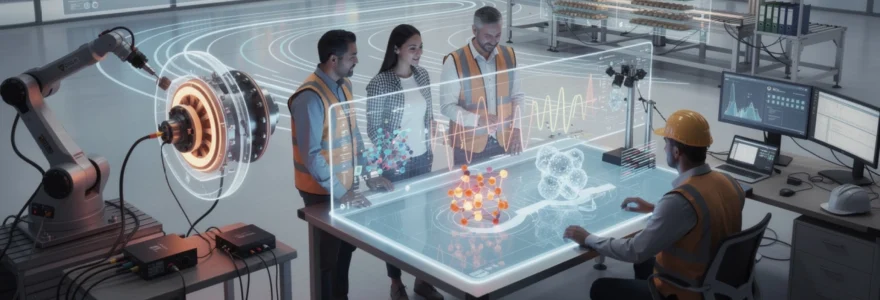
Machine learning has emerged as the cornerstone of modern engineering innovation, fundamentally transforming how engineers approach complex problems across industries. From predictive maintenance systems that prevent costly equipment failures to computer vision applications that ensure product quality, machine learning algorithms are reshaping traditional engineering practices. This technological revolution enables engineers to process vast amounts of data, identify patterns invisible to human analysis, and make decisions with unprecedented precision and speed.
The integration of machine learning into engineering workflows represents more than just technological advancement—it signifies a paradigm shift towards data-driven decision making and intelligent automation. Engineers now leverage sophisticated neural networks, computer vision systems, and reinforcement learning algorithms to optimise processes, reduce costs, and improve safety across manufacturing, infrastructure, and industrial systems. This transformation is particularly evident in how machine learning enhances predictive capabilities, automates quality control processes, and enables autonomous system operations that were previously impossible.
Neural networks and deep learning architectures in predictive maintenance systems
Predictive maintenance represents one of the most impactful applications of machine learning in engineering, with neural networks serving as the backbone of these sophisticated systems. Traditional maintenance approaches relied on fixed schedules or reactive responses to equipment failures, often resulting in unnecessary costs or unexpected downtime. Deep learning architectures now enable engineers to predict equipment failures weeks or months in advance, fundamentally changing maintenance strategies across industries.
The power of neural networks in predictive maintenance lies in their ability to process multiple data streams simultaneously, including vibration patterns, temperature fluctuations, acoustic emissions, and operational parameters. These systems learn complex relationships between various sensor inputs and equipment health states, creating predictive models that continuously improve their accuracy over time. Modern predictive maintenance systems can achieve accuracy rates exceeding 95% in failure prediction, significantly reducing unplanned downtime and maintenance costs.
Industrial facilities implementing neural network-based predictive maintenance systems report average cost reductions of 25-30% in maintenance expenses whilst achieving 70-75% reductions in unplanned equipment failures.
Convolutional neural networks for vibration analysis in rotating machinery
Convolutional Neural Networks (CNNs) excel at analysing vibration signatures from rotating machinery, treating vibration data as images that reveal hidden patterns indicative of mechanical wear or impending failure. These networks process frequency domain representations of vibration signals, identifying subtle changes that traditional analysis methods might miss. The spatial hierarchies within CNN architectures mirror the complex frequency relationships present in mechanical vibrations, making them particularly effective for this application.
Engineers implement CNNs to analyse bearing defects, gear wear patterns, and shaft misalignments by converting time-series vibration data into spectrograms or wavelet transforms. This approach enables the detection of fault signatures at their earliest stages, often identifying problems months before traditional vibration analysis would flag them. Advanced CNN architectures can simultaneously monitor multiple frequency bands and their harmonic relationships, providing comprehensive machinery health assessments that inform precise maintenance timing decisions.
Long Short-Term memory networks for Time-Series failure prediction
Long Short-Term Memory (LSTM) networks address the temporal dependencies inherent in equipment degradation processes, making them invaluable for time-series failure prediction in engineering systems. Unlike traditional neural networks that process data points independently, LSTMs maintain memory of past observations, enabling them to understand how equipment conditions evolve over time. This temporal awareness is crucial for predicting failures that develop gradually through wear, fatigue, or environmental exposure.
LSTM implementations in predictive maintenance systems typically process sequential sensor data spanning weeks or months, learning degradation patterns specific to different equipment types and operating conditions. These networks excel at identifying subtle trends in sensor readings that precede failures, often detecting degradation patterns that human analysts would overlook. The bidirectional LSTM variant further enhances prediction accuracy by analysing data sequences in both forward and backward directions, capturing temporal dependencies that might influence failure progression.
Autoencoders in anomaly detection for industrial equipment monitoring
Autoencoders provide powerful anomaly detection capabilities by learning to reconstruct normal operating patterns and flagging deviations that may indicate potential equipment problems. These unsupervised learning models train exclusively on data from healthy equipment operations, developing an internal representation of normal system behaviour. When presented with new data, autoencoders attempt to reconstruct the input, with reconstruction
error is used as a proxy for abnormal behaviour. When the reconstruction error exceeds a predefined threshold, the system flags the instance as anomalous, prompting further investigation by maintenance teams. In practical terms, this means an autoencoder can continuously monitor high-dimensional sensor data streams and raise alerts when operating conditions deviate from the learnt baseline, even if the exact failure mode has never been seen before.
In modern engineering solutions, autoencoder-based anomaly detection is particularly valuable for complex assets such as turbines, compressors, and high-speed production lines where labelled failure data is scarce. By focusing on what “normal” looks like rather than trying to catalogue every possible fault, engineers create robust early warning systems that generalise well to new conditions. Variational autoencoders and denoising autoencoders further improve resilience by handling noisy inputs and modelling uncertainty, making anomaly detection in industrial equipment monitoring more reliable and interpretable.
Recurrent neural networks for sequential sensor data processing
Recurrent Neural Networks (RNNs) extend the capabilities of deep learning in predictive maintenance by explicitly modelling sequential dependencies in sensor streams. While LSTMs are a specialised form of RNN, many engineering teams still employ vanilla RNNs or gated recurrent units (GRUs) when the temporal patterns are simpler or when computational constraints demand lighter models. These architectures excel at capturing short-term dynamics in sensor data such as pressure spikes, torque fluctuations, or transient thermal events that may precede equipment degradation.
In a typical industrial Internet of Things (IIoT) setup, RNNs process multi-channel sensor sequences in near real time, generating rolling health scores or remaining useful life (RUL) estimates for each asset. Because these networks update their internal state with every new reading, they provide engineers with continuously refreshed insights rather than static snapshots. This sequential sensor data processing is crucial in environments where conditions change rapidly, such as high-throughput manufacturing lines or power generation facilities subject to variable loads.
To improve robustness, engineers often combine RNNs with other architectures in hybrid models—for example, using a CNN front-end to extract features from vibration spectrograms and an RNN back-end to track their evolution over time. This fusion allows predictive maintenance systems to benefit from both spatial and temporal pattern recognition, leading to more accurate and timely failure predictions. As a result, modern engineering solutions can move from periodic inspections to continuous, data-driven asset monitoring.
Computer vision applications in quality control and defect detection
Computer vision has become a cornerstone of modern engineering quality control, enabling automated defect detection at scales and speeds that manual inspection cannot match. By training deep learning models to recognise imperfections in images or video streams, engineers can enforce consistent quality standards across production lines while reducing labour costs and human error. These machine learning-based quality control systems are particularly powerful when integrated directly into manufacturing equipment, where they provide real-time feedback and closed-loop process control.
From detecting microscopic surface scratches to verifying complex assemblies, computer vision in manufacturing quality control leverages high-resolution cameras and sophisticated neural networks. The shift from rule-based image processing to data-driven models means systems can adapt to new product variants and lighting conditions with minimal reprogramming. As defect rates drop and traceability improves, manufacturers gain a significant competitive advantage through higher yields and fewer product returns.
YOLO algorithm implementation for real-time manufacturing defect identification
The YOLO (You Only Look Once) family of algorithms has become a go-to solution for real-time defect identification in modern engineering environments. Unlike traditional object detection methods that scan an image multiple times, YOLO processes the entire frame in a single pass, making it fast enough for in-line inspection on high-speed production lines. This capability is crucial when engineers must detect defects on parts moving at several metres per second without slowing down throughput.
In a typical deployment, engineers fine-tune a YOLO model on a labelled dataset of product images showing both acceptable and defective items. The network learns to localise and classify issues such as missing components, misalignments, dents, or contaminations with bounding boxes and confidence scores. Because YOLO-based defect detection operates in real time, it can trigger immediate actions such as ejecting faulty parts, adjusting machine parameters, or pausing the line for human review.
To maximise reliability, many organisations employ a staged rollout: they start with a conservative configuration that flags borderline cases for manual confirmation, then gradually tighten thresholds as confidence in the model grows. This approach allows you to integrate AI-driven defect detection into your quality control process without risking sudden disruptions. Over time, models can be retrained with new defect examples, ensuring that the system evolves alongside product designs and process changes.
Opencv integration with TensorFlow for surface crack detection
Surface crack detection is a classic example of how combining traditional image processing with deep learning yields robust engineering solutions. OpenCV provides a rich toolkit for pre-processing images—such as filtering noise, enhancing contrast, and performing edge detection—while TensorFlow offers powerful deep learning frameworks for classification and localisation. By integrating these tools, engineers can build end-to-end pipelines that detect cracks on concrete, metal, glass, or composite surfaces with high accuracy.
A typical crack detection workflow starts with OpenCV routines that normalise lighting conditions and isolate regions of interest, making subtle fissures more visible. These pre-processed images are then passed to a TensorFlow-based CNN that has been trained to distinguish between normal texture and actual structural defects. The result is a system that not only spots obvious cracks but also identifies hairline fractures that could compromise safety if left unnoticed.
Why does this hybrid approach work so well in real-world engineering? Think of OpenCV as the skilled technician who prepares and positions a part under the microscope, and TensorFlow as the expert who interprets what they see. Each component plays to its strengths, and together they deliver reliable surface crack detection suitable for bridges, pipelines, wind turbine blades, and other critical infrastructure. As inspection data accumulates, models become more robust, enabling predictive maintenance and lifecycle optimisation.
Semantic segmentation using U-Net architecture for material classification
Semantic segmentation takes computer vision in quality control a step further by assigning a class label to every pixel in an image. The U-Net architecture, originally developed for biomedical image segmentation, has become a popular choice for material classification in engineering. Its “U-shaped” design, with symmetric encoder and decoder paths connected by skip connections, allows the model to capture both global context and fine details—ideal for distinguishing between different materials or surface states.
In a manufacturing context, U-Net-based semantic segmentation can differentiate between coatings, substrates, weld seams, corrosion spots, and contaminants at pixel-level resolution. This granular understanding enables engineers to quantify the exact area affected by defects, assess coating thickness uniformity, or verify that the correct materials have been used in complex assemblies. Such insights are far more precise than simple pass/fail decisions and support data-driven process optimisation.
Implementing U-Net for material classification typically involves training on annotated images where each pixel is labelled according to its material type or condition. Although creating these annotations can be time-consuming, the resulting models provide highly detailed maps of material distribution that would be impossible to obtain manually at scale. For organisations pursuing advanced quality control in sectors like aerospace, automotive, or energy, U-Net-powered semantic segmentation becomes a strategic asset.
Optical character recognition in automated quality assurance workflows
Optical Character Recognition (OCR) plays a critical but often overlooked role in automated quality assurance workflows. Modern engineering products frequently carry serial numbers, batch codes, barcodes, and safety markings that must be verified for traceability and compliance. OCR systems, powered by machine learning and deep learning, automatically read and validate this information from images or video frames, eliminating the need for manual data entry.
In production environments, OCR in quality assurance may verify that the correct laser-etched code appears on each component, that date stamps are legible, or that labels match the work order. When integrated with manufacturing execution systems (MES) and enterprise resource planning (ERP) platforms, OCR ensures that every item can be traced back through the supply chain, supporting recalls, warranty claims, and regulatory audits. This automation reduces paperwork, speeds up inspections, and improves data accuracy.
To handle real-world variability—such as skewed labels, varying fonts, or partially obscured markings—modern OCR engines leverage convolutional and recurrent networks trained on large datasets. Engineers can further improve robustness by combining OCR with rule-based checks, such as verifying checksum digits or cross-referencing scanned codes against expected patterns. The result is a resilient OCR pipeline that quietly underpins many of the most demanding engineering quality control processes.
Natural language processing for technical documentation and knowledge management
Natural Language Processing (NLP) is reshaping how engineering organisations create, manage, and retrieve technical knowledge. Instead of relying on static document repositories and manual searches, teams can now use NLP-driven systems to extract insights from specifications, maintenance logs, test reports, and standards. This shift turns unstructured text into a searchable, analysable asset that supports faster decision-making and more consistent engineering solutions.
One key application is intelligent search across technical documentation. By using semantic search models, engineers can ask questions in plain language—such as “What torque specification applies to the Model X gearbox?”—and receive precise answers drawn from thousands of pages of manuals and design notes. This saves valuable time and reduces the risk of missing critical information. In effect, NLP-powered knowledge management systems act like a seasoned colleague who always knows where the relevant document is filed.
NLP also boosts productivity in documentation authoring and maintenance. Machine learning models can suggest standardised wording, auto-complete recurring phrases, and flag inconsistencies between related documents. For instance, if a design change modifies a component’s operating temperature, NLP tools can help identify all manuals, datasheets, and procedures that reference the old range. This ensures that your documentation ecosystem stays coherent as products evolve—an increasingly important task in regulated industries.
Another powerful capability lies in analysing field reports and maintenance logs. Sentiment analysis and topic modelling can reveal recurring pain points, emerging failure modes, or common installation errors that might not be obvious from individual entries. By aggregating insights from thousands of free-text reports, organisations gain a data-driven view of product performance in the field. This feedback loop supports continuous improvement in both design and service operations, making NLP a key enabler of modern engineering solutions.
Reinforcement learning in autonomous system control and optimisation
Reinforcement Learning (RL) introduces a new paradigm for controlling and optimising autonomous engineering systems. Instead of hard-coding control rules or relying solely on traditional PID controllers, RL agents learn optimal behaviours through trial and error in simulated or real environments. This approach is especially valuable in complex systems where the dynamics are difficult to model analytically, or where operating conditions change frequently.
In modern engineering solutions, reinforcement learning supports applications ranging from robotic assembly lines to energy management systems and adaptive process control. By defining a reward function that encodes engineering objectives—such as minimising energy consumption, maximising throughput, or reducing wear—engineers can train agents that discover control strategies beyond human intuition. The result is often improved performance, greater robustness, and more flexible automation.
Q-learning algorithms for robotic path planning in manufacturing environments
Q-Learning is one of the foundational algorithms in reinforcement learning and finds practical use in robotic path planning for manufacturing environments. In this setting, the robot navigates a workspace filled with obstacles, workstations, and other moving agents. The goal is to reach targets efficiently while avoiding collisions and minimising travel time—objectives that align naturally with a reward-based learning framework.
By discretising the workspace into states and defining actions such as move forward, turn left, or turn right, a Q-learning agent iteratively updates a Q-table that estimates the expected reward for each state-action pair. Over time, the robot learns optimal routes that account for typical traffic patterns and layout constraints. Although tabular Q-learning is more common in low-dimensional problems, engineers can extend the approach using function approximation when dealing with larger state spaces.
In practice, training often begins in simulation to avoid risks in the physical plant. Once the agent demonstrates safe and efficient behaviour, policies can be transferred to real robots, sometimes with additional fine-tuning using real-world feedback. This staged approach enables you to leverage reinforcement learning for robotic path planning without compromising safety or disrupting existing workflows.
Deep Q-Networks in adaptive control systems for process optimisation
Deep Q-Networks (DQNs) extend the principles of Q-learning by using neural networks to approximate the Q-function, enabling reinforcement learning in high-dimensional, continuous state spaces. In engineering, DQNs are particularly useful for adaptive control systems where process dynamics are complex, non-linear, or subject to frequent disturbances. Examples include chemical reactors, HVAC systems in large buildings, and advanced manufacturing processes.
Instead of manually tuning control parameters, engineers define a reward function that captures process optimisation goals, such as maintaining product quality within tight tolerances while minimising energy usage. The DQN observes the current state of the system—sensor readings, setpoints, and control outputs—and learns which actions lead to the highest long-term reward. Over many episodes of interaction, often starting in a digital twin environment, the network converges on a policy that outperforms static control strategies.
One of the main advantages of DQNs in adaptive control is their ability to handle complex trade-offs. For instance, a process might need to ramp up production quickly without overshooting temperature limits or causing equipment stress. By learning directly from historical or simulated experience, DQNs can discover nuanced control strategies that balance these competing objectives more effectively than manually crafted rules. As a result, reinforcement learning becomes a powerful tool for continuous process optimisation in modern engineering solutions.
Policy gradient methods for multi-agent coordination in smart factories
As factories become smarter and more connected, coordinating multiple autonomous agents—robots, conveyors, automated guided vehicles (AGVs), and even software services—becomes a central challenge. Policy gradient methods in reinforcement learning offer a natural way to tackle this multi-agent coordination problem. Instead of learning value functions, policy gradient algorithms directly optimise the parameters of a policy that maps states to actions, making them well-suited to continuous action spaces and collaborative behaviours.
In a smart factory, each agent may have its own policy but share a global objective, such as maximising overall throughput or minimising energy consumption. Multi-agent policy gradient methods allow these agents to learn cooperative strategies, for example by staggering their movements to avoid traffic jams or dynamically sharing tasks based on current workloads. This is akin to a well-rehearsed orchestra where each musician follows their own score but listens and adapts to the ensemble.
To ensure stability and safety, training typically occurs in a simulated environment that accurately reflects the factory layout, machine capabilities, and operational constraints. Techniques such as centralised training with decentralised execution help agents learn to coordinate while preserving scalability at runtime. Once deployed, these policies enable more resilient and flexible production systems that can adapt to demand fluctuations, equipment failures, or process changes with minimal human intervention.
Actor-critic networks in dynamic resource allocation for cloud infrastructure
Actor-Critic architectures combine the strengths of value-based and policy-based reinforcement learning, making them ideal for dynamic resource allocation in cloud infrastructure. In this context, the “actor” proposes actions—such as scaling virtual machines up or down, adjusting container placements, or reallocating storage—while the “critic” evaluates how good those actions are in terms of long-term performance and cost. Together, they learn to manage resources efficiently under varying workloads.
Engineering teams running large-scale simulations, digital twins, or data processing pipelines often face unpredictable compute demands. Over-provisioning wastes money, while under-provisioning leads to slow performance and missed deadlines. Actor-Critic networks address this by continuously monitoring metrics like CPU usage, memory consumption, queue lengths, and response times, then dynamically adjusting resources to maintain service-level objectives.
Viewed through an engineering lens, this is similar to an automated control system for your cloud infrastructure, with reinforcement learning replacing static threshold rules. Because the Actor-Critic model learns from experience, it can adapt to seasonal patterns, new workloads, or changing performance targets without constant manual retuning. This capability is increasingly important as more engineering workflows—simulation, design optimisation, and predictive analytics—migrate to cloud-native architectures.
Machine learning operations (MLOps) integration in engineering workflows
As machine learning moves from proof-of-concept experiments to mission-critical engineering systems, integrating MLOps practices becomes essential. MLOps—short for Machine Learning Operations—extends DevOps principles to the entire ML lifecycle, from data ingestion and model training to deployment, monitoring, and retraining. For engineering teams, adopting MLOps means turning isolated algorithms into reliable, maintainable components of larger solutions.
One core benefit of MLOps in engineering workflows is reproducibility. By versioning datasets, model configurations, and training code, you ensure that results can be traced and replicated, which is crucial in regulated environments. Tools such as experiment trackers, feature stores, and automated pipelines help coordinate work between data scientists, software engineers, and domain experts. This reduces handoff friction and shortens the time between model development and production deployment.
Continuous integration and continuous delivery (CI/CD) pipelines tailored for ML allow new models to be validated and rolled out with minimal downtime. Techniques like shadow deployments, A/B testing, and canary releases help verify that updated models improve performance without introducing regressions. In predictive maintenance or quality control systems, this means you can safely incorporate new sensor data or defect types while keeping existing operations stable.
Monitoring is another pillar of effective MLOps. Beyond traditional infrastructure metrics, engineers track model-specific indicators such as prediction drift, data quality, and confidence scores. When anomalies are detected—perhaps due to a shift in operating conditions or sensor behaviour—automated alerts trigger retraining workflows or fallback strategies. This closes the loop between model performance and real-world outcomes, ensuring that machine learning remains a trustworthy part of modern engineering solutions over the long term.
Edge computing and real-time ML inference in industrial IoT systems
Edge computing brings machine learning closer to where data is generated, enabling real-time inference in industrial IoT systems. Instead of sending all sensor data to the cloud for processing, models run directly on embedded devices, gateways, or local servers near the machinery. This approach reduces latency, saves bandwidth, and improves resilience when network connectivity is limited or intermittent—common realities in factories, remote pipelines, and offshore platforms.
For time-critical applications such as robotic safety zones, emergency shutdown systems, or high-speed visual inspection, even a few hundred milliseconds of delay can be unacceptable. Deploying ML models at the edge allows decisions to be made within microseconds to milliseconds, supporting stringent real-time requirements. Compressed and quantised models, along with specialised hardware accelerators, ensure that sophisticated algorithms can run efficiently on resource-constrained devices.
Edge-based ML inference also enhances data privacy and security. Sensitive operational data, proprietary process parameters, or images of restricted equipment can be processed locally, with only aggregated insights or alerts sent to central systems. This minimises exposure to cyber threats and simplifies compliance with data protection regulations. For organisations operating in defence, pharmaceuticals, or critical infrastructure, this local intelligence is a decisive advantage.
From an architectural perspective, the most effective industrial IoT solutions combine edge computing with cloud-based coordination. The edge handles fast, local decision-making, while the cloud manages fleet-wide model updates, long-term data storage, and large-scale analytics. Think of it as a two-level nervous system: reflexes occur at the edge for immediate response, while the “brain” in the cloud analyses trends and plans future actions. By embracing this hybrid model, engineering teams can fully exploit machine learning to create responsive, reliable, and scalable industrial systems.