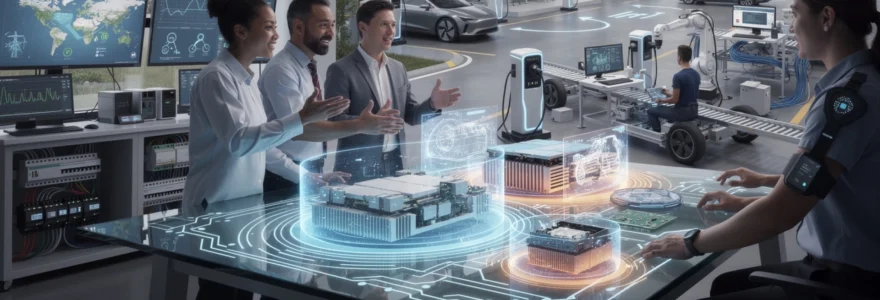
The landscape of electrical engineering continues to evolve at an unprecedented pace, driven by technological breakthroughs and the growing demand for sustainable, intelligent systems across every sector of the modern economy. From transforming how power grids operate with advanced smart technologies to revolutionising healthcare through sophisticated biomedical devices, electrical engineers are at the forefront of innovation that shapes our daily lives. The convergence of artificial intelligence, Internet of Things connectivity, and advanced materials science has opened new frontiers in electrical engineering applications, creating opportunities to solve complex challenges in energy management, industrial automation, transportation, and beyond. As industries increasingly embrace digital transformation and sustainability initiatives, the role of electrical engineering has expanded beyond traditional power systems to encompass cutting-edge solutions in renewable energy integration, autonomous systems, and next-generation communication networks.
Smart grid technologies and distributed energy management systems
Modern electrical engineering has fundamentally transformed the way power systems operate through the development of intelligent grid infrastructure that responds dynamically to changing energy demands and supply conditions. Smart grid technologies represent one of the most significant advances in electrical engineering, combining traditional power delivery systems with advanced digital communication, automation, and analytics capabilities. These sophisticated networks enable real-time monitoring and control of electrical distribution, optimising efficiency whilst reducing operational costs and environmental impact.
The integration of distributed energy resources has become increasingly crucial as renewable energy adoption accelerates globally. Smart grid systems facilitate seamless interconnection of various energy sources, including solar panels, wind turbines, and energy storage systems, creating a more resilient and flexible power infrastructure. This distributed approach to energy generation allows for greater grid stability and reduces dependence on centralised power plants, particularly during peak demand periods or emergency situations.
Advanced metering infrastructure (AMI) implementation in renewable energy networks
Advanced Metering Infrastructure represents a cornerstone technology in modern electrical engineering applications, enabling utilities to collect detailed consumption data and communicate directly with customer premises. These intelligent systems provide granular visibility into energy usage patterns, allowing for more accurate billing, demand forecasting, and grid optimisation. AMI deployments typically achieve measurement accuracies of 99.5% or higher, significantly improving upon traditional mechanical meters.
The integration of AMI with renewable energy networks creates unprecedented opportunities for dynamic pricing models and demand response programmes. Smart meters can automatically adjust pricing based on real-time grid conditions, encouraging consumers to shift energy usage to periods when renewable generation is abundant. This capability has proven particularly valuable in regions with high solar penetration, where midday pricing can reflect the abundance of photovoltaic generation.
Microinverter technology and power electronics for solar PV integration
Microinverter technology has revolutionised solar photovoltaic installations by addressing the limitations of traditional string inverter systems. Unlike conventional approaches that connect multiple panels in series, microinverters operate at the individual panel level, maximising energy harvest even when some panels experience shading or performance degradation. This distributed power conversion approach typically increases system output by 15-25% compared to string inverter configurations.
The power electronics within microinverters utilise advanced semiconductor materials and sophisticated control algorithms to achieve conversion efficiencies exceeding 96%. Maximum Power Point Tracking algorithms continuously optimise each panel’s operating point, whilst built-in monitoring capabilities provide detailed performance data for maintenance and troubleshooting purposes.
Battery energy storage systems (BESS) with tesla powerwall and LG chem solutions
Battery Energy Storage Systems have emerged as critical components in modern electrical infrastructure, providing grid stabilisation services whilst enabling greater renewable energy integration. Leading solutions such as Tesla Powerwall and LG Chem battery systems demonstrate the rapid advancement in energy storage technology, offering residential and commercial customers the ability to store excess renewable generation for later use.
These sophisticated systems incorporate advanced Battery Management Systems (BMS) that monitor individual cell voltages, temperatures, and state of charge to ensure optimal performance and safety. Modern lithium-ion battery installations can achieve round-trip efficiencies of 90-95%, with service lives exceeding 10,000 charge cycles when properly managed.
Demand response algorithms using machine learning and IoT sensors
The application of machine learning algorithms to demand response programmes represents a significant advancement in electrical engineering, enabling more sophisticated prediction and control of energy consumption patterns. These
systems learn from historical consumption data, weather forecasts, and occupancy patterns captured by IoT sensors to anticipate when loads are likely to increase or decrease. Instead of relying on static tariff schedules, utilities can deploy adaptive demand response strategies that automatically adjust HVAC setpoints, shift industrial processes, or control EV charging in response to grid conditions. For large commercial facilities, this can translate into peak demand reductions of 10–20%, while maintaining occupant comfort through fine-grained control strategies.
From the consumer side, smart thermostats, connected appliances, and building management systems participate in these programmes with minimal user intervention. You can think of this as an “autopilot for energy use,” where algorithms continuously search for the lowest-cost, lowest-carbon operating point. Electrical engineers are responsible for designing secure control architectures, communication protocols, and fail-safe mechanisms so that automated load shedding never compromises safety or critical operations. The combination of demand response algorithms, IoT sensors, and real-time analytics is turning traditionally passive consumers into active participants in grid balancing.
Vehicle-to-grid (V2G) technology integration with electric vehicle charging infrastructure
Vehicle-to-Grid technology extends the role of electric vehicles from simple loads to dynamic, distributed energy storage assets that support smart grid technologies. In a typical V2G deployment, bi-directional EV chargers allow energy to flow both from the grid to the vehicle and from the vehicle back to the grid when needed. Aggregated across hundreds or thousands of vehicles, this mobile storage capacity can provide frequency regulation, peak shaving, and backup power services, especially during high-demand events or renewable generation dips.
Electrical engineers play a critical role in designing the power electronics, communication interfaces, and control strategies that make V2G viable. They must ensure that charging infrastructure complies with grid codes, protects vehicle batteries from accelerated degradation, and coordinates with utility SCADA systems for dispatch. Pilot projects in Europe and North America have already demonstrated that well-managed V2G programmes can generate several hundred euros or dollars in annual grid services revenue per participating EV, while enhancing overall system resilience. As EV adoption grows, this integration between transportation and power systems will become a cornerstone of distributed energy management.
Industrial automation and control systems engineering
Industrial automation has long been a core application area for electrical engineering, but the emergence of Industry 4.0 has dramatically expanded its scope. Today’s factories blend advanced control systems with cloud connectivity, data analytics, and cyber-physical integration to achieve unprecedented levels of efficiency and flexibility. Electrical engineers are responsible for designing the hardware and software that orchestrate programmable logic controllers, drives, sensors, and industrial networks into cohesive automation solutions.
Across manufacturing, process industries, and critical infrastructure, modern control architectures enable real-time optimisation of production lines, predictive maintenance, and energy-efficient operation. By integrating automation systems with enterprise IT platforms and industrial IoT sensors, engineers can transform legacy plants into smart factories that respond dynamically to demand, raw material availability, and equipment health. This shift is not just about replacing manual tasks with robots; it is about creating integrated, intelligent systems that improve quality, safety, and competitiveness.
Programmable logic controller (PLC) programming with siemens TIA portal
Programmable Logic Controllers remain the workhorses of industrial automation, providing deterministic, reliable control for machinery and process equipment. Platforms such as Siemens TIA Portal have become central engineering tools, enabling electrical engineers to program PLCs, configure human–machine interfaces (HMIs), and integrate drives and distributed I/O within a single environment. This unified approach streamlines commissioning and reduces the time needed to modify or expand production lines.
Using ladder logic, function block diagrams, or structured text, engineers implement control sequences for tasks such as conveyor coordination, batch mixing, and safety interlocking. TIA Portal also supports simulation and virtual commissioning, allowing control strategies to be tested against digital twins of production systems before hardware is deployed. This “test before you wire” capability reduces on-site debugging, minimises downtime, and helps ensure that automated systems behave as intended under both normal and fault conditions.
SCADA systems integration using wonderware and GE iFIX platforms
Supervisory Control and Data Acquisition (SCADA) systems provide the high-level monitoring and control layer that sits above PLCs and field devices in many industrial environments. Platforms such as AVEVA Wonderware and GE iFIX enable operators to visualise plant status, trend key performance indicators, and issue control commands from central control rooms. Electrical engineers are responsible for integrating these SCADA systems with underlying controllers, sensors, and enterprise databases.
In practice, this involves configuring communication drivers, designing intuitive graphical user interfaces, and implementing alarm management strategies that highlight critical events without overwhelming operators. Modern SCADA platforms also support historian databases and analytics, turning raw process data into actionable insights for maintenance and process optimisation. When properly engineered, SCADA integration can reduce unplanned downtime by enabling faster fault diagnosis, while also supporting regulatory reporting and quality assurance in highly regulated industries such as pharmaceuticals or water treatment.
Variable frequency drive (VFD) applications in motor control systems
Variable Frequency Drives are essential components in energy-efficient motor control, enabling precise adjustment of motor speed and torque according to process requirements. Rather than running motors at full speed and throttling flow mechanically, VFDs modulate the supply frequency and voltage, dramatically reducing energy consumption in applications such as pumps, fans, and compressors. Studies commonly show energy savings of 30–50% when fixed-speed motors are replaced with VFD-controlled systems in variable-load applications.
Electrical engineers design and specify VFD systems to match motor characteristics, load profiles, and environmental conditions. They must account for harmonic distortion, electromagnetic compatibility, and proper thermal management within switchboards or control panels. In addition to energy efficiency, VFDs can improve process control by enabling soft-starting, controlled acceleration and deceleration, and torque limiting, which reduces mechanical stress on equipment. As plants pursue decarbonisation and cost reduction, optimised VFD deployment is often one of the fastest payback measures in industrial electrical engineering.
Industrial ethernet protocols: profinet, EtherCAT, and modbus TCP implementation
The migration from traditional fieldbuses to industrial Ethernet has transformed how automation devices communicate, supporting higher data rates, greater flexibility, and easier integration with IT networks. Protocols such as Profinet, EtherCAT, and Modbus TCP each offer distinct advantages in terms of determinism, topology, and configurability. Electrical engineers must understand these protocols to design robust communication architectures that meet real-time control requirements while remaining secure and maintainable.
For motion control applications requiring microsecond-level synchronisation, engineers often favour EtherCAT due to its high-speed, deterministic performance. Profinet is widely used in discrete manufacturing and process industries, offering flexible network topologies and broad device support. Modbus TCP remains popular for simple, vendor-neutral connectivity between controllers, drives, and monitoring systems. Implementing these protocols involves careful network segmentation, switch selection, and cybersecurity measures to protect against unauthorised access or disruption. In effect, the industrial Ethernet backbone becomes the nervous system of the smart factory, carrying critical information between sensors, actuators, and higher-level control systems.
Power electronics innovations in electric vehicle technology
Electric vehicles rely heavily on advanced power electronics to manage energy flow between batteries, traction motors, chargers, and auxiliary systems. The efficiency, size, and reliability of these power conversion stages directly influence vehicle range, performance, and cost. Electrical engineers specialising in EV power electronics are pushing the boundaries of semiconductor technology, converter topologies, and thermal management to deliver compact, high-efficiency systems that can withstand demanding automotive environments.
From onboard chargers and DC–DC converters to inverters that drive high-speed motors, every watt lost as heat represents reduced range or increased cooling requirements. As a result, innovations in power electronics are among the most impactful levers for improving EV competitiveness. You can think of these systems as the “circulatory system” of the electric vehicle, routing energy where it is needed with minimal losses and maximum control.
Silicon carbide (SiC) and gallium nitride (GaN) semiconductor applications
Wide-bandgap semiconductors such as Silicon Carbide and Gallium Nitride have emerged as game-changers in EV power electronics. Compared with traditional silicon devices, SiC and GaN components can operate at higher voltages, switching frequencies, and temperatures, while exhibiting lower conduction and switching losses. In practical terms, this means smaller, lighter inverters and chargers with efficiencies exceeding 98%, directly contributing to longer driving ranges and reduced cooling system complexity.
SiC MOSFETs are increasingly used in traction inverters and high-voltage DC–DC converters for their ability to handle hundreds of kilowatts with excellent efficiency. GaN devices, with their ultra-fast switching capability, are particularly attractive for onboard chargers and lower-power converters where size and weight are critical. Electrical engineers must adapt gate drive circuits, layout practices, and protection schemes to fully exploit these materials, managing fast voltage transitions and minimising electromagnetic interference. As manufacturing costs continue to fall, adoption of SiC and GaN is expected to become standard in next-generation EV platforms.
Bidirectional DC-DC converter design for EV powertrains
Bidirectional DC–DC converters are central to managing energy between the main traction battery and various subsystems in an EV, including low-voltage auxiliary networks and, increasingly, external loads in vehicle-to-load or vehicle-to-grid scenarios. These converters must efficiently step voltage up or down while allowing power to flow in both directions under precise control. Typical designs employ soft-switching techniques and multi-phase interleaving to achieve high power density and reduced ripple.
From an engineering perspective, designing these converters involves trade-offs between efficiency, cost, control complexity, and packaging constraints. Engineers must select appropriate topologies—such as dual active bridge or interleaved buck–boost—based on power levels and operating voltage ranges. Robust control algorithms are required to manage mode transitions, fault conditions, and interactions with other powertrain components. As EV architectures evolve toward zonal power distribution and integrated power electronics modules, sophisticated bidirectional DC–DC converters will remain key enablers of flexible, efficient energy management.
Wireless power transfer (WPT) systems using magnetic resonance coupling
Wireless power transfer offers a compelling alternative to plug-in charging, improving user convenience and enabling new use cases such as automated fleet charging or dynamic charging embedded in roadways. Most EV-focused WPT systems rely on magnetic resonance coupling between primary coils in the charging pad and secondary coils in the vehicle. When carefully tuned, this resonant interaction can transfer significant power—tens of kilowatts—across air gaps of several centimetres with efficiencies approaching those of wired chargers.
Electrical engineers developing WPT systems must address a range of challenges, from coil design and compensation networks to power factor correction and grid interface compliance. Precise alignment detection, foreign object detection, and electromagnetic field containment are critical for both safety and efficiency. You might compare this to tuning two musical instruments to the same frequency: when they resonate together, energy transfer is smooth and powerful. As standards mature and pilot deployments expand, magnetic resonance-based WPT is likely to become a standard option for high-end EVs and commercial fleets.
Thermal management solutions for high-power inverter systems
High-power inverters and converters in EVs generate substantial heat, especially under aggressive driving or fast-charging conditions. Effective thermal management is therefore essential to maintain component reliability and prevent derating, which would reduce available power. Electrical and mechanical engineers collaborate to design cooling solutions that may include liquid-cooled cold plates, heat pipes, and advanced thermal interface materials to efficiently extract heat from power semiconductor modules.
Accurate thermal modelling is crucial, allowing engineers to predict temperature distributions and evaluate design options before committing to hardware. As power densities increase with SiC and GaN adoption, traditional air cooling often becomes insufficient, pushing the industry toward more sophisticated liquid cooling architectures that integrate with the vehicle’s overall thermal system. By optimising thermal paths and reducing hotspots, engineers can extend component lifetimes and maintain high efficiency, even in compact packaging. In many ways, thermal design has become as important as electrical design in modern EV inverter development.
Telecommunications infrastructure and 5G network engineering
Telecommunications infrastructure has undergone a profound transformation with the rollout of 5G networks, and electrical engineering underpins much of this evolution. 5G promises ultra-low latency, massive device connectivity, and gigabit-level data rates, enabling applications from autonomous vehicles to remote surgery. Achieving these performance targets requires dense deployments of small cells, advanced antenna systems, and highly efficient radio frequency (RF) front-ends, all of which depend on sophisticated electrical design.
Engineers working on 5G network engineering must integrate power systems, RF components, fibre backhaul, and edge computing resources into compact, weatherproof enclosures that can be mounted on street furniture or building facades. Power efficiency is critical, as telecom networks account for a significant share of global ICT energy consumption. Techniques such as dynamic power management, advanced rectifiers, and DC power distribution are used to minimise losses and support renewable energy integration at base station sites.
Another major innovation in this space is Massive MIMO (Multiple-Input Multiple-Output) and beamforming, which use arrays of antennas and complex signal processing to direct radio energy precisely where it is needed. Electrical engineers design the phased array systems, low-noise amplifiers, and power amplifiers that make this possible. As networks evolve toward 6G and beyond, the convergence of telecommunications, cloud computing, and edge AI will continue to create opportunities for electrical engineers to shape the future of pervasive connectivity.
Biomedical electronics and wearable health monitoring systems
Biomedical electronics sits at the intersection of electrical engineering and healthcare, delivering devices and systems that monitor, diagnose, and even treat medical conditions. From implantable pacemakers and defibrillators to portable electrocardiogram monitors and smart insulin pumps, electrical engineers design circuits, sensors, and wireless communication interfaces that must meet stringent safety and reliability requirements. The rapid growth of telemedicine and remote patient monitoring is accelerating demand for compact, low-power biomedical electronics.
Wearable health monitoring systems are among the most visible innovations in this field. Smartwatches and fitness bands continuously track heart rate, activity levels, and sleep patterns, while more specialised devices measure electrocardiograms, blood oxygen saturation, or even blood pressure. Engineers must integrate biocompatible sensors, low-noise analogue front-ends, microcontrollers, and Bluetooth or cellular connectivity into form factors that are comfortable and unobtrusive. Low power consumption is essential so that users are not constantly recharging their devices, often requiring clever power management and energy-efficient signal processing algorithms.
Beyond consumer applications, clinical-grade wearables support remote monitoring of chronic conditions such as heart failure, diabetes, or respiratory disease. By streaming data to cloud-based platforms where machine learning models detect anomalies, these systems can enable early intervention and reduce hospital admissions. You can think of them as a “continuous check-up,” turning sporadic clinical measurements into rich, longitudinal datasets. Electrical engineers must also address cybersecurity and data privacy, encrypting data in transit and at rest to protect sensitive health information while maintaining reliable, real-time connectivity.
Aerospace electrical systems and avionics integration
Aerospace electrical systems represent one of the most demanding application domains for electrical engineering, where safety, reliability, and weight reduction are paramount. Modern aircraft are increasingly adopting “more-electric” architectures, replacing hydraulic and pneumatic systems with electrically driven actuators, pumps, and compressors. This shift improves energy efficiency and maintainability but also places greater demands on power generation, distribution, and protection systems onboard.
Avionics integration is another critical area, encompassing flight control computers, navigation systems, communication radios, and cockpit displays. These systems must operate flawlessly in harsh environments, with wide temperature variations, vibration, and electromagnetic interference. Electrical engineers design redundant power supplies, fault-tolerant data buses, and robust shielding to ensure continuous operation under all conditions. Certification standards such as DO-160 and DO-254 impose rigorous design, testing, and documentation processes, reflecting the high stakes involved in aerospace applications.
Emerging aerospace technologies, including more-electric regional aircraft, urban air mobility vehicles, and electric or hybrid-electric propulsion systems, further highlight the role of innovative electrical engineering. High-voltage DC distribution, lightweight power electronics, and advanced energy storage solutions are enabling new aircraft concepts that aim to reduce emissions and noise. In satellite systems and space missions, engineers must also design radiation-tolerant electronics and highly efficient solar power systems, often with no possibility of repair once deployed. Across these diverse applications, electrical engineering provides the foundation for safer, cleaner, and more capable aerospace platforms.