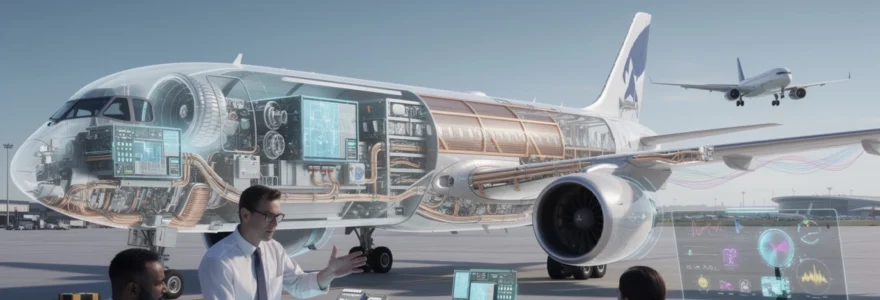
The aerospace industry stands at the precipice of an electrical revolution that promises to transform every aspect of modern aviation. From the sophisticated power electronics that enable more efficient propulsion systems to the advanced digital signal processing capabilities powering next-generation avionics, electrical engineering innovations are fundamentally reshaping how aircraft are designed, operated, and maintained. This transformation extends beyond simple component upgrades; it represents a comprehensive reimagining of aircraft architecture that prioritises sustainability, efficiency, and unprecedented levels of automation.
Modern commercial aircraft now incorporate electrical systems that would have been considered science fiction just two decades ago. The integration of wide bandgap semiconductors, advanced electromagnetic compatibility solutions, and sophisticated fly-by-wire control systems has created aircraft that are not only more environmentally friendly but also significantly safer and more reliable. As the industry moves toward electric and hybrid-electric propulsion architectures, the role of electrical engineers in aerospace development has become more critical than ever before.
Power electronics revolution in aircraft propulsion systems
The transformation of aircraft propulsion systems through advanced power electronics represents one of the most significant technological leaps in modern aviation. Traditional mechanical and hydraulic systems are increasingly being replaced by sophisticated electrical alternatives that offer superior efficiency, reliability, and environmental performance. This shift has created new opportunities for implementing cutting-edge semiconductor technologies that were previously confined to ground-based applications.
Power electronics in modern aircraft must operate under extreme conditions, including wide temperature variations, high altitudes, and intense electromagnetic environments. The development of specialised inverters, converters, and motor controllers specifically designed for aerospace applications has enabled the creation of more electric aircraft (MEA) architectures that reduce weight, improve fuel efficiency, and enhance overall system reliability.
Silicon carbide inverters in boeing 787 dreamliner electric architecture
The Boeing 787 Dreamliner pioneered the use of silicon carbide (SiC) power electronics in commercial aviation, demonstrating the transformative potential of wide bandgap semiconductors in aerospace applications. These advanced inverters operate at significantly higher switching frequencies than traditional silicon-based devices, enabling more compact and efficient power conversion systems throughout the aircraft.
Silicon carbide inverters in the 787 provide superior thermal performance, allowing for reduced cooling requirements and more compact packaging. The higher operating temperatures possible with SiC devices have eliminated the need for complex liquid cooling systems in many applications, resulting in weight savings of approximately 15-20% compared to equivalent silicon-based systems. These inverters also demonstrate exceptional reliability, with failure rates 50% lower than conventional power electronics.
Gallium nitride semiconductors for High-Frequency motor controllers
Gallium nitride (GaN) semiconductors have emerged as the next frontier in aircraft motor control applications, offering even greater performance advantages than silicon carbide in specific high-frequency applications. These devices excel in applications requiring rapid switching and precise control, such as the variable-speed motor drives used in environmental control systems and fuel pump applications.
The exceptional switching characteristics of GaN devices enable motor controllers to operate at frequencies exceeding 100 kHz, dramatically reducing the size and weight of associated magnetic components. Modern GaN-based motor controllers achieve power densities of over 20 kW per kilogram, representing a threefold improvement over silicon-based alternatives. This performance enhancement is particularly crucial in electric and hybrid-electric propulsion systems where weight optimisation directly impacts flight range and payload capacity.
Variable frequency drives in airbus A350 environmental control systems
The Airbus A350 incorporates sophisticated variable frequency drives (VFDs) throughout its environmental control architecture, demonstrating how advanced power electronics can optimise energy consumption across multiple aircraft systems. These drives precisely control the speed of compressors, fans, and pumps based on real-time demand, resulting in energy savings of up to 30% compared to fixed-speed alternatives.
Modern VFDs in the A350 utilise advanced sensorless control algorithms that eliminate the need for position feedback sensors, reducing system complexity and improving reliability. The integration of predictive maintenance capabilities within these drives enables proactive identification of potential issues before they result in system failures. This intelligent monitoring has reduced unscheduled maintenance events by approximately 25% compared to previous-generation aircraft.
Wide bandgap power
devices also contribute to improved power quality and reduced electromagnetic interference (EMI). By switching more cleanly and operating at higher frequencies, SiC and GaN devices generate less harmonic distortion in aircraft electrical networks, simplifying filter design and allowing lighter, more compact EMI mitigation components. For aeronautical engineers focused on electric propulsion, this combination of higher efficiency, lower weight, and improved EMI behaviour is a key enabler of the more electric aircraft vision.
Advanced avionics integration through digital signal processing
While power electronics are revolutionising aircraft propulsion, digital signal processing (DSP) is transforming how data is handled in the cockpit. Modern avionics suites depend on high-speed processors, field-programmable gate arrays (FPGAs), and sophisticated algorithms to fuse, filter, and present critical flight information in real time. This tight integration of electrical engineering and aeronautics has made aircraft smarter, safer, and more autonomous than ever before.
Advanced DSP techniques allow avionics systems to handle vast amounts of sensor data—radar returns, inertial measurements, GPS signals, and engine parameters—without overwhelming pilots. Instead of displaying raw data, these systems synthesise information into intuitive visuals and alerts. As a result, pilots can focus on decision-making rather than data interpretation, which directly improves operational safety and efficiency.
Fpga-based flight management computer architectures
Flight management computers (FMCs) are the brain of modern airliners, and FPGAs now sit at the heart of many new FMC architectures. Unlike fixed-function microcontrollers, FPGAs can be reconfigured at the hardware level, enabling parallel processing of navigation, guidance, and performance calculations. This is particularly important for next-generation flight management that must handle 4D trajectory optimisation, Required Navigation Performance (RNP), and satellite-based augmentation data.
By offloading time-critical tasks—such as navigation filtering, flight path predictions, and integrity checks—to FPGA logic, avionics manufacturers achieve deterministic response times measured in microseconds. This ultra-low latency is crucial when aircraft are operating in dense airspace or executing complex approach procedures. Another advantage is lifecycle flexibility: as regulations or navigation standards evolve, airlines can update FPGA firmware rather than replacing entire avionics boxes, reducing cost and downtime.
Real-time data acquisition systems in honeywell primus epic displays
Honeywell’s Primus Epic integrated avionics platform illustrates how electrical engineering advances in real-time data acquisition and DSP directly benefit aeronautics. The system continuously collects data from hundreds of sensors—covering air data, inertial measurements, engine parameters, and structural loads—and streams it to its display and processing units. High-speed serial buses and optimised sampling schemes ensure that critical parameters are always updated within a few milliseconds.
Within the Primus Epic displays, DSP algorithms filter out noise, compensate for sensor biases, and detect anomalies in real time. For example, subtle trends in engine vibration or temperature can be flagged early, feeding into predictive maintenance systems that help avoid in-flight failures. For pilots, the result is a clean, prioritised presentation of information on large-format screens, with synthetic vision, integrated charts, and runway awareness features derived from that continuous flow of processed data.
Synthetic aperture radar processing for weather detection systems
Synthetic aperture radar (SAR) and advanced weather radar systems rely heavily on DSP to turn raw microwave reflections into actionable information. Unlike traditional radar, which gives a simple intensity return, SAR-style processing can reconstruct high-resolution images of weather cells and terrain by combining signals collected over time as the aircraft moves. This is where high-performance digital processors and optimised algorithms make a tangible difference to flight safety.
Modern airborne weather radars can distinguish between rain, hail, and turbulence by analysing the Doppler shift and polarisation of returned signals. DSP pipelines perform fast Fourier transforms, clutter rejection, and adaptive beamforming in real time, giving pilots more accurate storm cell contours and hazard predictions. As electric and hybrid-electric aircraft begin operating more point-to-point regional routes, this enhanced weather awareness will be essential for maintaining schedule reliability while avoiding hazardous conditions.
Digital filter implementation in rockwell collins pro line fusion
Rockwell Collins (now Collins Aerospace) Pro Line Fusion avionics suite demonstrates how carefully designed digital filters underpin reliable flight data. Every sensor feeding the system—from pitot tubes to attitude sensors—introduces some level of noise and transient artefacts. DSP-based digital filters remove these unwanted components while preserving the dynamic behaviour pilots and automated systems need to see.
For example, low-pass and band-pass filters implemented in software smooth out turbulence-induced spikes in attitude data, creating stable inputs for autopilot and fly-by-wire systems. At the same time, notch filters can eliminate interference from specific frequencies, such as those generated by high-power radio transmitters or variable frequency drives on board. Because these filters are implemented digitally, engineers can refine their characteristics through software updates, improving performance without changing hardware—an important advantage in a tightly regulated aeronautics environment.
Fly-by-wire control systems and sensor fusion technologies
Fly-by-wire (FBW) technology is one of the clearest examples of how aeronautics is benefiting from electrical engineering innovations. In FBW aircraft, mechanical linkages are replaced by electrical signals, with flight control computers interpreting pilot inputs and commanding actuators accordingly. This transformation would be impossible without robust electronics, sensor fusion algorithms, and high-assurance software engineering.
Instead of a direct cable connecting the pilot’s control column to the control surfaces, FBW systems rely on multiple redundant sensors—measuring attitude, airspeed, angle of attack, and load factors—to determine the aircraft’s state. Sensor fusion algorithms combine these diverse inputs into a single, coherent picture, much like how our brain merges signals from both eyes and the inner ear to maintain balance. This enables “envelope protection,” where the system prevents pilots from unintentionally exceeding structural or aerodynamic limits.
From an engineering perspective, the key challenge is ensuring deterministic, fail-safe behaviour even in the presence of sensor failures or electromagnetic interference. Redundancy is built at every level: triplex or quadruplex flight control computers, multiple independent data buses, and voting logic that detects and isolates faulty signals. As electric and hybrid-electric propulsion introduces new dynamic behaviours, we can expect next-generation FBW systems to perform even more complex control tasks, such as coordinating distributed electric propulsors for optimal efficiency and noise reduction.
For airlines and operators, these electrical engineering advances in flight control translate into smoother flights, reduced pilot workload, and improved fuel efficiency. For you as a passenger, they mean safer operations and more stable handling, even in gusty or turbulent conditions. It is a subtle benefit, but every time an aircraft automatically corrects for a wind gust or prevents an over-rotation at take-off, you are seeing sensor fusion and FBW technology silently at work.
Electric and hybrid-electric propulsion architectures
Electric and hybrid-electric propulsion architectures represent the next major frontier where aeronautics and electrical engineering deeply intersect. While fully electric commercial airliners remain a long-term goal, we are already seeing viable applications in training aircraft, regional aviation, and urban air mobility. These architectures rely on high-efficiency electric motors, advanced batteries or fuel cells, and tightly integrated power management systems designed by electrical engineers.
In a typical hybrid-electric configuration, combustion engines and electric motors share the propulsion load. During take-off and climb, when power demand peaks, electric motors can supplement turbofans or turboprops, allowing smaller and more efficient combustion engines to be used. During cruise, the combustion engines may drive generators that recharge batteries or power electric propulsors directly. This arrangement is similar to a hybrid car but must meet much stricter constraints on weight, reliability, and thermal management.
One of the core challenges is energy storage. Current lithium-ion batteries offer an energy density roughly one-fortieth that of jet fuel, which means aircraft designers must aggressively optimise weight, aerodynamics, and propulsion efficiency. Electrical engineers are pushing battery technologies—lithium-sulphur, solid-state batteries, and even structural batteries that form part of the airframe—to close this gap. At the same time, hydrogen fuel cell systems are being developed to provide clean, high-energy-density power for regional aircraft, converting hydrogen and oxygen into electricity with only water vapour as exhaust.
Another crucial aspect is power distribution. High-voltage DC networks, often operating in the 540–1000 V range, are being explored to minimise current, reduce cable weight, and improve overall system efficiency. However, higher voltages demand more sophisticated insulation, arc-fault detection, and protection strategies. This is where the expertise of electrical engineers in high-voltage design, grounding, and fault management becomes indispensable for safe aeronautical deployment.
What does this mean for the future of flight? In the near term, you can expect to see more hybrid-electric regional aircraft and electric air taxis operating short routes, particularly around cities and densely populated regions. These aircraft will be quieter, emit less CO2, and open new point-to-point connections. In the longer term, as energy storage improves, electric propulsion could fundamentally reshape aircraft configurations—distributed propulsors along the wings, boundary-layer ingestion fans at the rear fuselage, and radically different airframes optimised around electric powertrains rather than jet engines.
Electromagnetic compatibility solutions in modern aircraft design
As aircraft systems become increasingly electric and digitally interconnected, electromagnetic compatibility (EMC) has become a central design concern. Advanced power electronics, high-frequency switching devices, and complex communication systems all share the same confined airframe, creating many opportunities for electromagnetic interference. Without robust EMC engineering, a high-power inverter could easily corrupt a critical navigation signal or disrupt fly-by-wire controls.
Modern aeronautics therefore relies heavily on electrical engineering techniques to ensure that every system can operate safely in a dense electromagnetic environment. This includes careful cable routing, filter design, shielding strategies, and grounding architectures. Engineers must also consider external threats, such as lightning strikes and high-intensity radiated fields from ground-based transmitters. The goal is not only to protect individual components but to ensure system-level resilience across the entire aircraft life cycle.
Shielding effectiveness calculations for composite fuselage structures
The shift from metal to composite fuselage structures—seen in aircraft like the Boeing 787 and Airbus A350—has introduced new challenges for EMC and lightning protection. Aluminium skins naturally provide a degree of electromagnetic shielding, but carbon fibre reinforced plastics behave very differently. To maintain protection levels, engineers must model and calculate shielding effectiveness across a wide frequency range, often using full-wave electromagnetic simulation tools.
These calculations inform decisions on where to embed conductive meshes, metallic foils, or specialised coatings within the composite layup. The aim is to create a continuous Faraday cage effect around the cabin and critical avionics bays, limiting the penetration of external electromagnetic fields. At the same time, designers must balance EMC performance against weight and manufacturability; adding too much metal to composites can negate some of their weight-saving benefits. This is a delicate optimisation problem where electrical engineers and aerostructures specialists must work hand in hand.
Lightning protection systems using expanded copper mesh networks
Lightning strikes on aircraft are not rare events; commercial airliners are typically struck once or twice a year. In metallic airframes, the current spreads across the skin and exits with relatively limited internal impact. Composite airframes, however, require dedicated lightning protection systems. One widely adopted solution is the use of expanded copper mesh (ECM) embedded near the outer surface of composite panels.
These copper meshes provide a low-impedance path for lightning currents, allowing them to flow along the fuselage and wings without damaging structural fibres or internal systems. Electrical engineers calculate current paths, peak currents—often exceeding 200 kA—and associated thermal loads to ensure the mesh and bonding points can withstand worst-case events. The result is a network of conductive pathways, bonding straps, and surge suppression components that quietly protect passengers and avionics every time a storm cell is encountered.
RF interference mitigation in thales TopSky air traffic management
Electromagnetic compatibility challenges are not limited to the aircraft itself; they extend into the wider air traffic management ecosystem. Thales TopSky, a widely deployed air traffic management (ATM) system, illustrates how RF interference mitigation is crucial for reliable communication, navigation, and surveillance. TopSky integrates radar, ADS-B, multilateration, and VHF/UHF communication channels, all operating in crowded radiofrequency environments.
To prevent cross-interference, electrical engineers design highly selective RF filters, low-noise amplifiers, and robust shielding for receiver front ends. They also implement intelligent frequency planning and adaptive algorithms that can detect and suppress interfering signals. For pilots and controllers, this RF hygiene manifests as clearer voice communications, more accurate radar tracks, and fewer lost data packets—vital factors in maintaining safe separation as airspace becomes busier.
Ground fault protection in high-voltage aircraft electrical networks
With the rise of high-voltage DC and AC systems in more electric and hybrid-electric aircraft, ground fault protection has become a critical safety function. A single insulation failure or damaged cable in a 1000 V bus can pose serious risks if not detected and isolated quickly. Unlike traditional low-voltage systems, high-voltage networks require specialised sensors and protection algorithms to locate faults without causing nuisance trips or excessive system downtime.
Electrical engineers deploy techniques such as insulation monitoring devices, differential current sensing, and zoned protection schemes to achieve this. These systems continuously measure leakage currents and impedance to ground, triggering protective actions when thresholds are exceeded. In many architectures, faults can be isolated to a specific feeder or subsystem, allowing the rest of the network to continue operating safely. For aeronautics, this level of granular protection is essential to ensure that a single electrical fault does not compromise propulsion, flight controls, or critical avionics.
As electric power levels in aircraft continue to rise, we can expect even more sophisticated protection strategies—drawing on experience from high-voltage DC grids and electric vehicles—to migrate into aerospace. The underlying goal remains the same: to harness the efficiency and sustainability benefits of electrical engineering innovations while maintaining the uncompromising safety standards that define modern aviation.