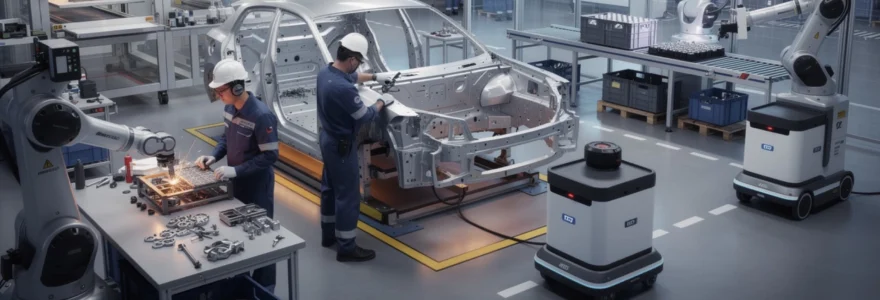
Manufacturing has entered an era of unprecedented technological evolution, where robotics and automation are no longer optional enhancements but essential components of competitive production strategies. The integration of intelligent systems, collaborative robots, and artificial intelligence is fundamentally reshaping how products are designed, assembled, and delivered to market. This transformation extends beyond simple efficiency gains—it represents a complete reimagining of manufacturing processes, workforce dynamics, and quality control methodologies. As Industry 4.0 technologies mature and become more accessible, manufacturers across all sectors face both exciting opportunities and significant challenges in adopting these advanced systems. The question is no longer whether to automate, but how to strategically implement these technologies to maximise productivity whilst maintaining workforce engagement and operational flexibility.
Collaborative robots (cobots) in automotive assembly lines
The automotive industry has historically been at the forefront of industrial automation, but the introduction of collaborative robots has revolutionised traditional assembly line paradigms. Unlike their industrial predecessors, which operated within safety cages separated from human workers, cobots are designed to work alongside people, sharing workspace and tasks in ways that were previously impossible. This fundamental shift has enabled manufacturers to combine the precision and consistency of robotic systems with the adaptability and problem-solving capabilities of skilled human operators. The result is a synergistic manufacturing environment where each component—human and machine—contributes its unique strengths to the production process.
Automotive manufacturers have discovered that cobots excel in applications requiring repetitive precision whilst allowing human workers to focus on complex assembly tasks, quality verification, and process optimisation. This division of labour has proven remarkably effective in addressing the dual challenges of maintaining production quality whilst managing skilled labour shortages. The flexibility of cobot systems means they can be reprogrammed and redeployed relatively quickly, making them ideal for manufacturers dealing with frequent model changes or customisation requirements. Recent implementations have demonstrated efficiency improvements ranging from 150% to 600% in specific applications, with concurrent improvements in worker satisfaction and safety metrics.
Universal robots UR10 integration for precision welding applications
The UR10 collaborative robot has become a benchmark for precision applications in automotive manufacturing, particularly in welding operations where consistency and accuracy are paramount. With a payload capacity of 10 kilograms and a reach of 1,300 millimetres, this cobot strikes an optimal balance between capability and accessibility. Its implementation in welding applications has addressed longstanding challenges related to weld quality variability, operator fatigue, and production throughput limitations. The UR10’s force-sensing capabilities allow it to detect and respond to variations in material positioning or joint gaps, adjusting welding parameters in real-time to maintain consistent results.
Manufacturing facilities deploying UR10 systems for welding have reported remarkable improvements in surface finish quality and dimensional accuracy. The robot’s ability to maintain consistent torch angles, travel speeds, and heat input eliminates the variability inherent in manual welding operations. Beyond quality improvements, the ergonomic benefits are substantial—removing operators from repetitive welding tasks reduces exposure to fumes, intense light, and uncomfortable working positions. This transition allows skilled welders to focus on setup, programming, and quality control functions that better utilise their expertise and command higher compensation.
FANUC CRX series deployment in BMW and ford manufacturing plants
BMW and Ford have been pioneers in deploying FANUC’s CRX series collaborative robots across their global manufacturing networks, implementing these systems in applications ranging from parts handling to final assembly operations. The CRX series offers an intuitive programming interface that has dramatically reduced the technical barriers to cobot adoption, allowing production engineers and experienced operators to program complex routines without extensive robotics training. This accessibility has proven crucial in scaling automation across multiple facilities and production lines, as it reduces dependency on specialised robotics engineers and accelerates deployment timelines.
Ford’s implementation strategy has focused on using CRX cobots for machine tending operations, where consistent loading and unloading of components into CNC machines and stamping presses has increased overall equipment effectiveness. By maintaining continuous machine operation during shift changes and breaks, these cobots have increased production capacity without requiring additional capital investment in manufacturing equipment. BMW has emphasised quality inspection applications, deploying CRX robots equipped with advanced vision systems to perform dimensional verification and surface defect detection. These implementations have achieved defect detection rates exceeding 99.5%, surpassing traditional
visual checks carried out by human operators, particularly on high-volume, high-variant models. In both organisations, the deployment of the CRX series has not been about replacing people but about stabilising quality, extending runtime, and freeing skilled staff to focus on problem-solving and continuous improvement activities.
Safety standards ISO 10218 and ISO/TS 15066 compliance requirements
The widespread adoption of collaborative robots in automotive manufacturing has been underpinned by the development of rigorous safety standards, most notably ISO 10218 and ISO/TS 15066. ISO 10218 defines the general safety requirements for industrial robots and robot systems, while ISO/TS 15066 provides specific guidelines for collaborative robot applications, including permissible force and pressure limits for human-robot contact. Compliance with these standards is not simply a regulatory checkbox; it is central to ensuring that robotics and automation enhance, rather than compromise, worker safety on the factory floor.
In practical terms, manufacturers implementing cobots must conduct detailed risk assessments that analyse each task, the workspace layout, and potential interaction points between humans and robots. These assessments inform the selection of control measures such as speed and separation monitoring, power and force limiting, and safety-rated monitored stops. Advanced sensor technologies—ranging from safety laser scanners to vision-based area monitoring—are then integrated with the robot controller to enforce safe operating zones dynamically. For you as a manufacturer, building a structured safety case around ISO 10218 and ISO/TS 15066 can also streamline internal approvals and insurer requirements, reducing project delays.
Another important aspect of compliance is documentation and training. ISO/TS 15066 emphasises not only the technical safeguards but also the need to inform and train operators about cobot behaviours, emergency stop procedures, and safe intervention protocols. Many leading automotive plants now embed safety briefings and simulated scenarios into onboarding programmes, ensuring that workers understand how collaborative robots respond to their presence. When done well, this builds confidence rather than apprehension, making it easier for teams to embrace robotics and automation as an everyday part of their work environment.
Human-robot interaction protocols in Mercedes-Benz production facilities
Mercedes-Benz has become a reference point for structured human-robot interaction (HRI) in highly automated automotive assembly lines. In its modern plants, cobots are deployed on tasks such as adhesive application, light fastening, and component placement, working in close proximity to technicians responsible for final alignment and quality checks. To orchestrate this safely and efficiently, the company has developed detailed HRI protocols that define how and when humans enter the robot’s workspace, how work is handed over, and how exceptions are managed. Think of these protocols as a “rules of the road” for shared work cells, designed to minimise ambiguity and ensure predictable behaviour from both people and machines.
Central to Mercedes-Benz’s approach is the use of speed and separation monitoring combined with power- and force-limited operation. Robots automatically slow down as a person approaches and can come to a complete stop if a defined safety boundary is crossed, then resume work once the area is clear. Visual indicators such as tower lights and projected floor markings communicate robot status and safe zones at a glance, reducing the cognitive load on operators. This kind of intuitive signalling is critical where multiple cobots and humans share a compact assembly area with varying takt times.
Equally important are the communication and escalation pathways when something goes wrong. Mercedes-Benz has standardised procedures for pausing a robot, flagging an anomaly, and escalating issues to maintenance or engineering support. Operators are trained not only in button presses but in understanding typical fault modes, so they can diagnose simple issues without waiting for a specialist. For manufacturers considering similar deployments, investing early in clear HRI protocols can pay dividends in productivity, worker acceptance, and long-term safety performance.
Industrial IoT and smart factory architecture implementation
While collaborative robots transform individual workstations, the broader evolution towards smart factories is being driven by industrial IoT (IIoT) platforms and connected architectures. In modern manufacturing, robots, CNC machines, conveyors, and quality systems increasingly act as intelligent nodes on a shared network, continuously streaming operational data. When this data is captured, contextualised, and analysed effectively, it unlocks powerful capabilities such as predictive maintenance, real-time production monitoring, and closed-loop optimisation. You can think of IIoT as the digital nervous system that allows robotics and automation to operate as part of a coordinated whole rather than as isolated islands of automation.
Siemens MindSphere platform for predictive maintenance analytics
Siemens MindSphere has emerged as a leading industrial IoT platform, particularly for manufacturers looking to scale predictive maintenance and performance analytics. By connecting PLCs, drives, robots, and sensors to the cloud, MindSphere aggregates condition data such as vibration signatures, temperature profiles, cycle counts, and fault codes. Machine learning models then analyse this data to detect anomalies that may precede failures—for example, a subtle increase in spindle vibration or longer-than-normal axis travel times. Instead of relying on fixed-interval servicing or reacting to breakdowns, maintenance teams can schedule interventions at the optimal time, reducing unplanned downtime and extending asset life.
For robotics-intensive production lines, this approach is especially valuable. Cobots and industrial robots may execute hundreds of thousands of cycles per week, and small mechanical or servo issues can quickly cascade into quality defects or stoppages. With predictive maintenance analytics, you can identify emerging problems before they impact output, such as joint wear in a robot arm or pressure fluctuations in a welding cell. Some manufacturers report maintenance-related downtime reductions of 30–50% after deploying IIoT-driven predictive strategies. The key is to start with a clear set of priorities—critical assets, failure modes, and KPIs—rather than attempting to monitor everything at once.
MindSphere also supports cross-site benchmarking, allowing corporate engineering teams to compare performance across multiple plants or lines. Are certain robots in one facility experiencing more faults than their counterparts elsewhere? Are energy consumption patterns deviating from expected norms? Answering questions like these can guide investment decisions, standardisation efforts, and process improvements on a global scale. When robotics and automation are tightly integrated with such analytics, they become not just tools for doing work, but rich sources of insight into how your manufacturing system actually behaves.
Edge computing integration with rockwell automation FactoryTalk systems
While cloud platforms are powerful, many manufacturing applications require millisecond-level response times and cannot tolerate the latency of roundtrips to remote data centres. This is where edge computing, particularly in combination with systems like Rockwell Automation’s FactoryTalk suite, becomes essential. Edge devices—industrial PCs or specialised gateways located close to the production line—collect and process data locally, running analytics, control logic, and visualisation without leaving the facility. Only summarised or non-time-critical information is sent to the cloud, striking a balance between speed, resilience, and scalability.
In a robotics and automation context, edge computing enables advanced functions such as real-time path optimisation, quality checks, and anomaly detection at the machine level. For example, an edge device connected to a welding cobot can analyse current, voltage, and travel speed signatures for each weld in real time, flagging deviations that may indicate a defect. Rather than waiting for an end-of-line inspection to catch the issue, the system can alert the operator immediately or even trigger an automatic process adjustment. The result is a more stable and capable manufacturing process with fewer surprises.
FactoryTalk, combined with edge computing, also simplifies integration between legacy equipment and modern robotics systems. Many plants operate a mix of old and new machines, each with different communication protocols. Edge gateways can act as translators, normalising data into common formats and exposing it through standard interfaces. This reduces the complexity of building a cohesive smart factory architecture and allows you to bring older assets into your digital transformation journey without wholesale replacement.
Real-time production monitoring through OPC UA communication protocols
Underpinning much of this connectivity is OPC UA (Open Platform Communications Unified Architecture), a vendor-neutral protocol designed specifically for industrial interoperability. OPC UA enables secure, structured data exchange between PLCs, robots, sensors, MES systems, and enterprise applications, regardless of manufacturer. For real-time production monitoring, this is crucial: instead of custom point-to-point interfaces for every device, you gain a standardised way to publish machine states, cycle times, alarm conditions, and quality metrics across your network.
Manufacturers using OPC UA in their robotics and automation environments can create unified dashboards showing live status across lines, cells, and even multiple plants. Imagine being able to see, at a glance, which cobots are running, which machines are idle, and where bottlenecks are forming, all from a central control room or remote device. This transparency supports faster decision-making and more effective escalation when problems arise. It also enables advanced capabilities like dynamic scheduling, where MES systems adjust job queues in response to real-time machine availability.
Security is another advantage of OPC UA. Built-in encryption, authentication, and role-based access control help protect connected production systems from unauthorised access or tampering—a growing concern as factories become more networked. For you, adopting OPC UA as a backbone for smart factory communication can simplify integration of new robotic cells and IIoT devices, reduce engineering effort, and provide a robust foundation for future automation projects.
Digital twin technology in general electric and airbus manufacturing operations
Digital twins—virtual representations of physical assets, processes, or entire factories—are becoming a cornerstone of advanced manufacturing strategies at companies like General Electric (GE) and Airbus. These organisations use digital twins to simulate, monitor, and optimise everything from turbine blade production to aircraft assembly workflows. By linking real-time data from sensors and robots to high-fidelity models, engineers can test process changes, predict outcomes, and identify issues long before they occur in the real world. It’s akin to having a “flight simulator” for your factory, where you can experiment without risking downtime or scrap.
At GE, digital twins of critical assets such as jet engine components and power turbines are used to model stress, temperature, and wear patterns based on actual operating data. In manufacturing, similar principles apply: robots, CNC machines, and conveyors are represented in a virtual environment, where cycle times, collision risks, and material flows are analysed. When the digital twin suggests that a particular robot motion leads to excessive joint stress or that a layout change could cut transfer time by 10%, engineering teams can validate and refine the solution before implementation.
Airbus has leveraged digital twins of its final assembly lines to evaluate different sequencing strategies, tooling configurations, and automation scenarios. By simulating how human operators and robots interact in a shared space, they can design workstations that are both efficient and ergonomically sound. For smaller manufacturers, the concept is equally applicable, even if the models are simpler. Starting with a digital twin of a single automated cell or line can help you de-risk investments in robotics and automation, ensure better right-first-time design, and support continuous performance tuning over the lifecycle of the equipment.
Artificial intelligence-driven quality control systems
As manufacturing tolerances tighten and product complexity increases, traditional sampling-based quality approaches often struggle to keep pace. Artificial intelligence (AI), particularly computer vision and machine learning, is transforming quality control from a reactive gatekeeping function into a proactive, embedded capability. AI-driven quality systems can inspect every part, detect subtle anomalies invisible to the human eye, and continuously improve their accuracy over time. When integrated with robotics and automation, they form a closed-loop system where defects are not only detected but traced back to root causes in real time.
Computer vision applications using cognex In-Sight vision cameras
Cognex In-Sight vision cameras are widely used across automotive, electronics, and consumer goods manufacturing for tasks such as presence verification, dimensional measurement, and surface inspection. These smart cameras combine high-resolution imaging with onboard processing and advanced algorithms, allowing them to make pass/fail decisions directly at the point of capture. When mounted on robots or integrated into conveyor lines, they provide continuous, high-speed inspection without slowing down production. For example, an In-Sight system can verify that all fasteners are present and correctly seated on a component before it leaves the station, reducing the risk of downstream rework.
One of the most powerful aspects of modern computer vision is its flexibility. Rather than relying solely on rigid, rule-based logic, many Cognex systems now incorporate AI tools that can learn from labelled examples of good and bad parts. This makes them more robust to natural variation in materials, lighting, or finishes—conditions that often cause false rejects in traditional systems. For you, this means fewer nuisance alarms and more reliable quality assurance, even as product variants and design details change.
From a practical standpoint, success with computer vision in manufacturing depends on good optics, consistent lighting, and careful application design. It can help to think of a vision project like building a good “camera studio” around your parts: the better the image quality and environmental control, the more accurate the AI can be. Starting with a pilot on a single critical feature or station allows you to validate performance and build internal expertise before expanding to more complex inspection tasks.
Machine learning algorithms for defect detection in semiconductor fabrication
Semiconductor fabrication is one of the most demanding manufacturing environments in the world, with feature sizes measured in nanometres and defect tolerances close to zero. In this context, machine learning has become indispensable for defect detection and yield optimisation. Wafer inspection tools generate vast amounts of image and metrology data; ML algorithms analyse these datasets to identify patterns correlated with specific defect types, process excursions, or equipment drift. Instead of relying solely on static control limits, fabs increasingly use predictive models that flag wafers or lots at risk of failure long before final electrical testing.
Supervised learning models can be trained on historical labelled data to distinguish between benign variations and truly problematic anomalies. Unsupervised techniques, such as clustering and anomaly detection, help discover previously unknown defect modes by highlighting data points that deviate from normal behaviour. These methods are particularly valuable as new process nodes and materials are introduced, where prior knowledge may be limited. In many cases, machine learning-driven defect detection has improved yield by several percentage points—an enormous gain in a high-capital, high-margin industry.
For manufacturers outside the semiconductor sector, the same principles apply at a different scale. Any process that generates rich sensor or image data can benefit from machine learning-based quality analytics. The key is to establish robust data pipelines, maintain high-quality labelling practices, and create cross-functional teams where process engineers and data scientists work together. When aligned with well-instrumented robotics and automation, machine learning can help you move from “inspect and reject” to “predict and prevent.”
Deep learning neural networks in tesla gigafactory production lines
Tesla’s Gigafactories have become synonymous with aggressive automation and data-driven optimisation, particularly in battery and powertrain manufacturing. Deep learning neural networks are applied to a range of inspection and process control tasks, from analysing weld seams and adhesive beads to verifying cell alignment and module integrity. High-speed cameras capture image streams as parts move along the line; convolutional neural networks (CNNs) process these images in real time, classifying defects and triggering immediate responses. In some cases, robots can adjust paths or parameters dynamically based on the AI’s assessment, closing the loop between quality control and actuation.
One advantage of deep learning in this environment is its ability to handle complex, high-dimensional data where traditional rules-based systems would be brittle. For example, variations in coating texture, reflection, or minor geometric distortion can all be interpreted by a CNN that has been trained on thousands of labelled examples. As the system encounters new edge cases, engineers can add them to the training set, gradually improving robustness. The result is a quality control system that gets smarter over time, rather like an experienced inspector who has “seen everything” but can still spot something new.
For other manufacturers, Tesla’s approach illustrates what is possible when robotics, computer vision, and AI are treated as an integrated stack rather than separate technologies. If you are just starting, you do not need Gigafactory-scale infrastructure; you can begin with a single deep learning model running on an edge device monitoring one critical step. Over time, as more processes are instrumented and more data is collected, you create the foundation for a truly intelligent manufacturing environment.
Autonomous mobile robots (AMRs) for material handling and logistics
Beyond the fixed workstations where products are assembled or processed, a significant share of manufacturing effort is consumed by internal logistics: moving raw materials, WIP, and finished goods between locations. Autonomous mobile robots (AMRs) are reshaping these material flows by providing flexible, software-defined transport capacity that can adapt to changing layouts and demand patterns. Unlike traditional automated guided vehicles (AGVs), which follow fixed tracks or magnetic tapes, AMRs use onboard sensors, maps, and path-planning algorithms to navigate dynamically around obstacles and people.
In practice, AMRs are being used to deliver components to assembly cells, remove completed pallets from the end of lines, and replenish kanban racks in just-in-time manufacturing systems. Because routes and priorities are managed through fleet management software, you can adjust behaviour with a few configuration changes rather than physically reworking infrastructure. This is particularly valuable in high-mix, low-volume environments or facilities undergoing continuous improvement, where static material handling systems struggle to keep pace. Some plants report reductions of 20–40% in manual forklift traffic after deploying AMRs, with corresponding improvements in safety and productivity.
Integration with existing robotics and automation is key to unlocking the full value of AMRs. For example, an AMR might deliver trays to a robotic picking station, where a cobot handles individual parts before signalling the AMR to move on. Using standard interfaces and IIoT platforms, AMRs can share status, location, and mission data with MES and WMS systems, enabling end-to-end tracking of material flows. If you are evaluating AMRs, it is worth starting with a detailed mapping of current manual transport tasks—who moves what, where, how often, and under what constraints. This will help you identify high-value use cases and avoid underutilisation or congestion as the fleet grows.
Additive manufacturing and robotic 3D printing integration
Additive manufacturing (AM), commonly known as 3D printing, is increasingly being combined with robotics to create highly flexible, digitally driven production systems. While early AM applications focused on prototyping, the integration of industrial robots with large-format printers and deposition heads is enabling direct printing of functional components, tools, and fixtures at or near the point of use. In a sense, robots become multi-axis “motion platforms” for additive processes, extending build volumes and enabling complex geometries that fixed gantry systems cannot easily achieve.
In manufacturing environments, robotic 3D printing is being used to produce custom end-of-arm tooling, ergonomic jigs, and lightweight fixtures tailored to specific parts or variants. This shortens lead times from weeks to days and reduces dependency on external machine shops. Some automotive and aerospace plants are also exploring hybrid cells where a robot performs both additive deposition and subtractive finishing, blending the strengths of each process. For you, this opens up possibilities for on-demand, localised production that supports rapid changeovers and continuous improvement initiatives.
Another emerging area is the use of additive manufacturing for spare parts and low-volume legacy components. Instead of maintaining large inventories or tooling for rarely ordered items, manufacturers can store validated digital models and print them when needed. When combined with robotics and automation for handling, post-processing, and inspection, this approach can significantly reduce inventory carrying costs and improve service responsiveness. The challenge lies in qualifying materials and processes to meet demanding industrial standards, but progress is rapid, and numerous certification frameworks are now in place across sectors such as aerospace and medical devices.
Workforce transformation and skill requirements in automated manufacturing environments
As robotics and automation become more pervasive, the nature of work in manufacturing is undergoing profound change. Routine manual tasks are increasingly handled by machines, while human roles shift towards oversight, optimisation, and cross-disciplinary problem-solving. This does not mean that people are any less important; rather, their contribution becomes more cognitive and collaborative. The “factory of the future” is as much about upskilling and cultural change as it is about deploying cobots, AMRs, and AI systems.
For workers, this transformation brings both opportunity and challenge. New roles are emerging in robot programming, data analysis, maintenance of complex mechatronic systems, and industrial cybersecurity. Technicians who once focused solely on mechanical tasks now need basic familiarity with software interfaces, networking concepts, and data interpretation. At the same time, soft skills—communication, adaptability, and continuous learning—become critical, as teams must coordinate across disciplines and respond to evolving technologies. If you are leading a manufacturing organisation, investing in structured training pathways and clear career progression routes is essential to retain talent and build confidence in automation initiatives.
On the organisational side, successful automation projects often hinge on early and genuine engagement with the workforce. Involving operators in cell design, safety assessments, and acceptance testing helps surface practical insights and reduces resistance to change. It also reinforces the message that robots are tools to support people, not replace them. Many forward-thinking manufacturers are partnering with colleges, universities, and industry bodies to develop apprenticeship schemes and micro-credential programmes focused on robotics, IIoT, and data-driven manufacturing. By building a pipeline of future-ready talent and supporting existing staff through reskilling, you can ensure that the benefits of automation—higher productivity, better quality, and safer workplaces—are shared across the organisation.