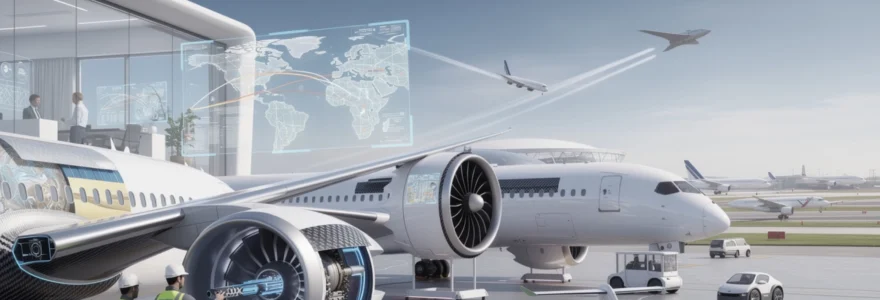
The aviation industry stands at the cusp of its most dramatic transformation since the introduction of jet propulsion in the 1950s. Modern aircraft are no longer simply faster or larger versions of their predecessors—they represent fundamental reimaginings of what aviation technology can achieve. From revolutionary composite materials that reduce weight by substantial margins to propulsion systems that slash fuel consumption, today’s aircraft embody decades of research, billions in investment, and an urgent response to environmental imperatives. These technological leaps are reshaping not only how we fly but also where we can fly economically, how airlines operate profitably, and crucially, how the sector addresses its environmental footprint. With aviation supporting approximately 87 million jobs globally and contributing nearly €3.8 trillion to the world economy, the stakes for successful innovation have never been higher.
Next-generation composite materials in airframe manufacturing
The materials revolution in aviation represents perhaps the most visible transformation in modern aircraft design. Traditional aluminium airframes, which dominated commercial aviation for decades, are steadily giving way to advanced composites that offer superior strength-to-weight ratios and enhanced durability. This shift isn’t merely incremental—it fundamentally alters aircraft economics, environmental performance, and maintenance requirements. Composite materials now constitute up to 50% of the primary structure in some cutting-edge aircraft models, a proportion that would have seemed impossible just two decades ago.
Carbon fibre reinforced polymer applications in boeing 787 dreamliner
The Boeing 787 Dreamliner exemplifies the revolutionary potential of carbon fibre reinforced polymers (CFRP) in commercial aviation. Approximately 50% of the aircraft’s primary structure, including the fuselage and wing, utilises CFRP composites. This extensive application delivers a weight reduction of roughly 20% compared to traditional aluminium construction, directly translating to fuel savings of approximately 20-25% on comparable routes. The material’s superior fatigue resistance means the aircraft can maintain higher cabin humidity and lower cabin altitude, significantly enhancing passenger comfort on long-haul flights. What makes CFRP particularly valuable is its resistance to corrosion, which eliminates many traditional maintenance concerns and extends component lifecycles substantially.
Aluminium-lithium alloys reducing aircraft weight by 10-15%
While composites capture headlines, aluminium-lithium alloys represent a sophisticated evolution of metallic airframe materials. These advanced alloys incorporate lithium to reduce density whilst maintaining or even improving strength characteristics compared to conventional aluminium alloys. The third-generation aluminium-lithium alloys now entering service deliver weight reductions of 10-15% whilst offering 15-20% improved stiffness. Airbus has deployed these materials extensively in the A350 XWB programme, where they complement composite structures in areas requiring specific material properties. The alloys prove particularly valuable in fuselage skins, where their damage tolerance and repairability exceed composite alternatives, addressing operator concerns about field maintenance capabilities.
Thermoplastic composites enabling rapid production cycles
Thermoplastic composites represent the aviation industry’s answer to manufacturing efficiency challenges. Unlike traditional thermoset composites, which require lengthy curing cycles in autoclaves, thermoplastic materials can be formed, cooled, and deployed far more rapidly. Manufacturing cycle times can be reduced by up to 75%, dramatically lowering production costs and enabling more responsive manufacturing. These materials also offer superior impact resistance and can be reformed or reshaped after initial manufacturing, opening possibilities for more efficient repairs. Major manufacturers are increasingly viewing thermoplastics as the pathway to affordable composite aircraft, potentially extending advanced materials to narrowbody and regional aircraft where cost pressures have historically limited composite adoption.
Graphene-enhanced structural components for increased durability
Graphene, the revolutionary single-layer carbon structure, is beginning to influence aviation materials science despite remaining largely in research phases. When incorporated into composite matrices, even small quantities of graphene can enhance electrical conductivity, thermal management, and mechanical properties. Early applications focus on lightning strike protection, where graphene-enhanced surfaces can safely dissipate electrical charges without the weight penalty of traditional copper mesh. Research programmes are exploring graphene-reinforced composites that could deliver 30% strength improvements whilst maintaining weight parity with current materials. Though
the most compelling near-term potential lies in multifunctional structures that combine load-bearing capability with embedded sensing or de-icing functions. For global transportation networks, this translates into aircraft that can fly longer between inspections, better withstand harsh environments, and maintain higher dispatch reliability. As graphene production scales and certification pathways mature, we can expect to see these enhanced composites move from test coupons and secondary parts into more critical airframe structures, further extending the lifespan and safety margins of modern aircraft.
Advanced propulsion systems revolutionising fuel efficiency
If advanced materials are the skeleton of modern aircraft, new propulsion systems are the beating heart of aviation’s transformation. Engine technology has always been a primary driver of efficiency gains, and contemporary propulsion innovations are delivering step changes in fuel burn, noise, and emissions. From geared turbofan architectures to hybrid-electric demonstrators, propulsion systems are being redesigned around both economic and environmental constraints. The result is a new generation of aircraft engines that can reduce greenhouse gas emissions while keeping global connectivity affordable.
Geared turbofan engines in pratt & whitney PW1000G series
The Pratt & Whitney PW1000G geared turbofan series illustrates how rethinking core engine architecture can transform fuel efficiency. By introducing a reduction gearbox between the fan and the low-pressure turbine, the engine allows each component to spin at its optimal speed. This seemingly simple mechanical change yields fuel savings of up to 16% compared with previous-generation engines on similar aircraft, along with noise reductions of around 50% on a perceived noise basis. For airlines operating high-frequency short-haul routes, these savings compound quickly, improving route economics and enabling more environmentally sustainable flight schedules.
From a global transportation perspective, geared turbofan engines also support the expansion of point-to-point networks by lowering operating costs on thinner routes. Aircraft families such as the Airbus A220 and A320neo, which rely heavily on PW1000G variants, can serve regional and secondary airports more economically, bringing direct international air services to cities that previously relied on long car or rail journeys to major hubs. For passengers, this means shorter door-to-door travel times and greater choice; for operators, it means the ability to right-size capacity while maintaining profitable load factors. The geared turbofan architecture is therefore not just an engineering achievement, but a catalyst for more flexible and efficient global connectivity.
Open rotor architecture reducing fuel consumption by 25%
Looking further ahead, open rotor—or unducted fan—architectures promise even more dramatic reductions in fuel burn. By removing the traditional nacelle and allowing larger, slower-turning propellers to operate in the free airstream, open rotor engines can improve propulsive efficiency by up to 25% compared with today’s best turbofans. Demonstrator programmes led by major engine manufacturers have already validated much of the underlying technology, although certification and community noise concerns remain active areas of development. The visual appearance of open rotors may evoke earlier turboprop aircraft, but the aerodynamics, materials, and controls are entirely 21st-century.
Why does a 25% fuel reduction matter so much for global transportation? On dense regional corridors and intra-continental routes, fuel costs remain one of the largest operating expenses for airlines, often exceeding 30% of total costs. If open rotor engines can deliver their projected performance while meeting noise and safety standards, they could make marginal routes profitable and enable new services between secondary cities. In practical terms, this could mean direct air links between mid-sized regional centres that are currently connected only via hubs or long car journeys, cutting travel time for both business and leisure travellers and supporting more balanced regional economic growth.
Hybrid-electric propulsion in airbus E-Fan X demonstrator
Hybrid-electric propulsion represents a different but equally transformative pathway, particularly for short- and medium-haul aviation. Although the Airbus E-Fan X demonstrator was ultimately cancelled in 2020, its goal—replacing one of four conventional turbofan engines on a regional jet with a 2-megawatt electric motor—pushed the industry to confront key questions about battery density, power electronics, and thermal management in real-world conditions. Lessons from E-Fan X and similar programmes have informed the next generation of hybrid-electric concepts, many targeting 19- to 100-seat aircraft with ranges between 300 and 1,000 kilometres.
For global transportation systems, hybrid-electric propulsion acts as a bridge technology. It reduces fuel burn and emissions on routes where full battery-electric flight is not yet viable, while preserving the flexibility and speed that make air travel attractive. We can think of hybrid-electric aircraft as the aviation equivalent of early hybrid cars: they may not eliminate fossil fuels overnight, but they significantly cut consumption and help build the industrial ecosystem—chargers, grid upgrades, and regulatory frameworks—needed for eventual zero-emission flight. In remote or underserved regions, such as islands or sparsely populated areas, these aircraft could offer cleaner, more reliable connectivity than current turboprop fleets, reinforcing social and economic links without dramatically increasing the sector’s carbon footprint.
Sustainable aviation fuel compatibility in CFM LEAP engines
While disruptive engine architectures attract attention, one of the most immediate levers for decarbonising global aviation is sustainable aviation fuel (SAF). CFM International’s LEAP engine family, powering aircraft such as the Boeing 737 MAX and Airbus A320neo, has been designed to be fully compatible with SAF blends of up to 50% today, with extensive testing under way toward 100% SAF operations. LEAP engines already achieve 15% lower fuel burn and CO2 emissions compared with their predecessors, thanks to technologies like 3D-printed fuel nozzles and advanced ceramic matrix composite components. When you combine these inherent efficiency gains with SAF deployment, life-cycle emissions on key routes can be cut substantially.
Of course, the key challenge is not just engine compatibility but SAF availability and cost. Current global SAF production represents less than 1% of total jet fuel demand, and prices remain significantly higher than conventional fuel. Nonetheless, by ensuring that modern engines like the LEAP can safely and efficiently burn SAF, manufacturers remove a major technical barrier and shift the focus to scaling production and building robust supply chains. For airlines planning long-term fleet investments, SAF-ready engines reduce regulatory risk and help align corporate strategies with national and international climate targets, all while keeping essential long-haul and short-haul connectivity intact.
Artificial intelligence and machine learning in flight operations
Beyond physical hardware, software is rapidly becoming a decisive factor in how modern aircraft support global transportation. Artificial intelligence (AI) and machine learning (ML) are moving from experimental projects to operational tools that influence maintenance, routing, and even ground movements. Just as navigation apps have transformed how we drive, AI-powered systems are beginning to reshape how aircraft are operated day to day. The objective is clear: maximise safety and reliability while minimising fuel burn, delays, and operational disruption.
Predictive maintenance algorithms minimising aircraft downtime
Predictive maintenance is one of the most mature and impactful applications of AI in aviation. By analysing data from thousands of sensors across engines, avionics, and airframe systems, machine learning algorithms can identify patterns that precede component degradation or failure. Instead of waiting for a scheduled check or reacting to an in-service fault, maintenance teams can intervene at the optimal moment, replacing parts only when necessary but before they cause unplanned downtime. Major airlines report reductions in unscheduled engine removals of up to 30% when using predictive analytics, as well as higher fleet utilisation and more consistent on-time performance.
From a passenger’s perspective, predictive maintenance translates into fewer last-minute cancellations and delays, particularly on hub-to-spoke routes where a single aircraft failure can ripple through an entire network. For operators, the economic benefits can be substantial: improved aircraft availability supports denser schedules and better asset productivity, while targeted interventions reduce inventory and labour costs. In a global transportation system that depends on tight connections between flights, rail, and road, this enhanced reliability helps keep supply chains moving smoothly and strengthens confidence in air travel as a dependable mode of transport.
Ai-powered flight route optimisation for emission reduction
AI is also transforming how flight routes are planned and flown. Traditional flight planning tools consider weather, airspace restrictions, and fuel burn, but they often do so using static models and conservative assumptions. AI-powered optimisation platforms incorporate live meteorological data, air traffic patterns, and aircraft performance characteristics to recommend more efficient routes and altitudes in near real time. In some cases, they can even update recommendations in flight, helping crews adjust to evolving conditions. Airlines using advanced optimisation tools have reported fuel savings in the range of 2–5% per flight—small percentages that add up to millions of tonnes of CO2 avoided annually across global fleets.
What does this look like in practice? On a transcontinental flight, AI might suggest slightly different altitudes and track deviations to exploit favourable tailwinds or avoid strong headwinds and convective weather, much like a sailor choosing currents. On shorter regional sectors, optimised climb and descent profiles can reduce both fuel use and noise over populated areas. As regulatory pressure intensifies and environmental performance becomes a competitive differentiator, the ability to fine-tune every phase of flight using AI becomes a key enabler of more sustainable global transportation, without compromising safety or journey times.
Autonomous taxi systems at singapore changi airport
Ground operations provide another fertile arena for AI and automation. At major hubs such as Singapore Changi Airport, autonomous taxi and towing concepts are being trialled to reduce fuel consumption and congestion on taxiways. In these systems, aircraft may be moved by semi-autonomous tugs or guided by advanced routing algorithms that coordinate movements across the airfield, much like an intelligent traffic control system in a smart city. By reducing idle engine time on the ground and minimising stop-start taxiing, airports can cut local emissions and noise while improving punctuality.
For passengers, the benefits manifest as smoother departure and arrival experiences, with fewer unexpected holds or long taxi times that eat into schedules. For airports operating near capacity, more efficient ground movements can effectively create additional “virtual” slots by shaving minutes off turnaround times. As global air travel demand recovers and grows—particularly in Asia-Pacific—such autonomous and semi-autonomous systems will be critical for handling higher traffic volumes without expanding physical footprints or significantly increasing environmental impact.
Aerodynamic innovations enhancing performance parameters
Aerodynamics may seem like a mature field, but incremental improvements in airflow management continue to deliver meaningful gains in performance, efficiency, and range. Modern aircraft designs employ sophisticated wing shapes, high-aspect-ratio configurations, and subtle surface treatments to reduce drag and improve lift-to-drag ratios. If we think of the aircraft as a long-distance runner, these aerodynamic tweaks are akin to lighter shoes and more efficient breathing—they may not be as visible as a new engine, but they can make the difference between merely finishing and winning.
One of the most widely adopted aerodynamic innovations is the winglet and its successors, such as sharklets and split-scimitar designs. By reducing wingtip vortices, these devices can improve fuel efficiency by 3–5% on many aircraft types, a substantial gain when multiplied across thousands of flights per year. More recent developments include natural laminar flow wings, which maintain smooth airflow over greater surface areas, and adaptive surfaces that can subtly change shape in response to flight conditions. These innovations not only lower fuel burn but also enhance climb performance and extend range, giving airlines more flexibility in choosing non-stop city pairs.
On the horizon, blended wing body (BWB) concepts and truss-braced wings promise even more radical aerodynamic advances. BWBs integrate the fuselage and wings into a single lifting surface, dramatically improving efficiency and potentially allowing for new cabin layouts, while truss-braced wings use slender, long-span wings supported by bracing structures to reduce drag. Both concepts are being studied intensively by manufacturers and space agencies, particularly for medium- to long-haul applications where their advantages are most pronounced. If successfully commercialised, these designs could redefine what modern aircraft look like and how they operate within the global transportation system, enabling longer ranges with less fuel and opening new ultra-long-haul routes.
Digital connectivity infrastructure transforming passenger experience
Alongside hardware and aerodynamic gains, digital connectivity is reshaping the passenger experience and the way airlines manage their operations. In-flight connectivity has evolved rapidly from a niche offering to an expectation, with high-throughput satellites and air-to-ground networks enabling broadband-level access on many routes. For travellers, this means the ability to work, stream, or communicate almost as freely in the sky as on the ground, blurring the line between travel time and productive time. For airlines, connected cabins are data-rich environments that can inform everything from catering planning to predictive maintenance of seat electronics.
On the ground, smart airport initiatives—leveraging 5G, cloud computing, and Internet of Things (IoT) sensors—are making journeys more seamless. Biometric boarding gates, mobile check-in, and real-time baggage tracking reduce friction points that once defined the air travel experience. Have you ever wondered why some journeys feel effortless while others are stressful, even when the flight time is the same? Often, the differentiator is how well digital systems anticipate and respond to your needs, from automatically rebooking you during disruptions to sending tailored wayfinding instructions to your phone. As these systems mature, they promise to make multi-modal journeys—combining air, rail, and road—more intuitive and easier to manage.
For global transportation networks, enhanced digital connectivity also supports better integration between stakeholders. Airlines, airports, ground handlers, and air navigation service providers can share data more effectively, enabling collaborative decision-making that optimises the overall system rather than individual segments. This might involve dynamic gate allocation to reduce taxi times, coordinated turnaround operations to minimise ground delays, or integrated travel apps that guide passengers from doorstep to destination. Ultimately, digital infrastructure is becoming as important to aviation as runways and terminals, underpinning a more resilient, responsive, and passenger-centric ecosystem.
Supersonic and hypersonic transport development projects
While many innovations focus on efficiency and sustainability, there is renewed interest in restoring one of aviation’s original promises: dramatically faster travel. Supersonic and hypersonic transport projects aim to cut intercontinental journey times by half or more, opening possibilities that once seemed confined to science fiction. Although Concorde proved that commercial supersonic travel was technically feasible, its economic and environmental limitations prevented widespread adoption. Today’s projects seek to overcome those barriers with improved aerodynamics, lighter materials, and cleaner propulsion systems.
Several private companies and research consortia are developing modern supersonic airliners targeting cruise speeds of around Mach 1.4 to Mach 1.7. These designs typically focus on premium, long-haul markets—such as transatlantic business travel—where passengers are willing to pay for significant time savings. Advances in computational fluid dynamics and wind tunnel testing are helping engineers refine nose and fuselage shapes to manage sonic boom signatures, potentially enabling overland supersonic operations if regulations evolve. At the same time, there is growing emphasis on using sustainable aviation fuels or even developing hydrogen-based concepts to align high-speed travel with global decarbonisation goals.
Hypersonic transport, operating at speeds above Mach 5, remains at a much earlier stage, with most activity concentrated in defence and experimental programmes. However, some long-term civil concepts envision flights that could connect any two points on Earth in under four hours. While such capabilities are unlikely to become mainstream for decades, the technologies being developed—advanced thermal protection systems, high-temperature materials, and novel propulsion methods like air-breathing scramjets—could eventually influence more conventional aircraft as well. Even if hypersonic passenger services remain niche, they highlight how modern aircraft continue to stretch the boundaries of what global transportation can achieve.
Crucially, any future supersonic or hypersonic transport will need to address not only speed but also noise, emissions, and affordability. The lessons learned from today’s push for sustainable aviation—using cleaner fuels, embracing efficient aerodynamics, and optimising operations through AI—will be directly applicable to high-speed concepts. In that sense, the industry’s current transformation is laying the groundwork for a future where faster flight does not have to come at the expense of the planet, but rather forms part of a balanced, efficient, and inclusive global mobility ecosystem.